

Bathroom Faucet Repairs Huntington Beach
Bathroom faucet problems are usually simple, but they’re annoying fast. A drip that won’t stop, a handle that feels loose, or a faucet base that keeps getting wet can turn into cabinet damage if it’s ignored.
Professional Plumbing Inc. handles bathroom faucet repairs in Huntington Beach with a clean, clear process: find the real leak source, explain your options, make the repair, then test it so it stays fixed. Your Home First means we protect your sink top, keep parts organized, and leave the area clean.
Quick answer: Most bathroom faucet leaks come from worn cartridges, stem washers, O-rings, aerator buildup, or leaking supply connections. The faucet “spread” (4″ CC vs 8″ CC) helps identify what faucet style you have and what parts or replacements will fit.
What bathroom faucet repairs usually involve
Most bathroom faucet repairs come down to one of these:
- Stopping a drip from the spout
- Fixing a leak at the handle
- Fixing water at the base (deck plate area)
- Fixing an under-sink leak (supply line, angle stop, shank connection)
- Restoring smooth handle movement and proper shutoff
The key is matching the repair to the faucet type, not guessing and swapping random parts.
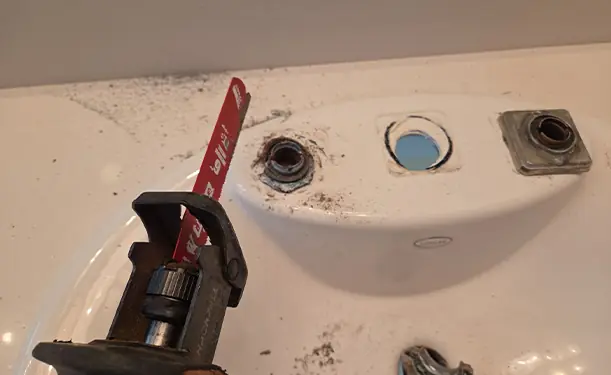
4″ CC vs 8″ CC faucets and why it matters
CC is the distance between handle centers (hot to cold).
“CC” means center-to-center measurement. It’s the spacing between the hot and cold handle centers on a two-handle faucet setup.
4″ CC (4-inch centerset)
- Hot and cold handles are 4 inches apart (center to center).
- Often a single combined unit (spout + handles) that mounts through 3 holes in the sink or countertop.
- Many bathroom sinks are set up for this style.
- Repairs often involve cartridge/stem parts inside the handles, plus O-rings and seals.
8″ CC (8-inch widespread)
- Hot and cold handles are 8 inches apart (center to center).
- The spout and handles are often separate pieces connected underneath.
- Common on nicer vanities and larger countertops.
- Repairs can include cartridge/stem parts, but also more under-sink connections because the parts are separated.
4″ CC is usually a centerset faucet, while 8″ CC is usually a widespread faucet. That spacing matters for replacement fit and for how the faucet is assembled underneath.
How to measure: put a tape measure at the center of the hot handle and measure straight to the center of the cold handle. If it’s about 4 inches, it’s 4″ CC. If it’s about 8 inches, it’s 8″ CC.
Common bathroom faucet leak sources
- Cartridge wear (single-handle and many two-handle faucets)
- Compression stem washer wear (older two-handle styles)
- O-ring failure (handle or spout seals)
- Valve seat wear (some faucet designs)
- Loose mounting nuts under the sink
- Supply line seepage or cracked supply lines
- Angle stop valve seepage
- Water sneaking under the base and soaking the deck/counter
- Aerator buildup that causes splashing and “false leak” symptoms around the sink deck
Most common failure point: seals and cartridges inside the handle area, especially when the handle starts feeling loose or gritty.
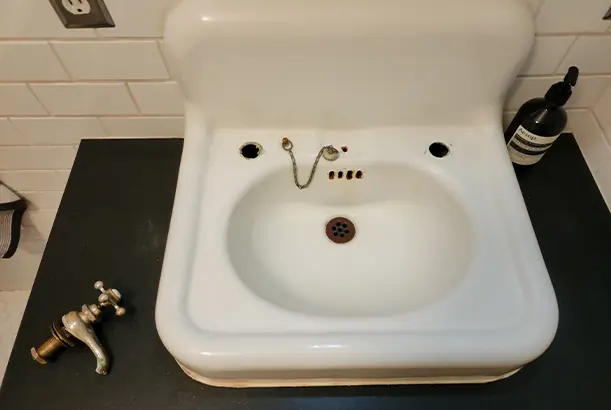
How we diagnose the problem
We keep it simple:
- Confirm where water is showing up (spout, handle, base, or under the sink)
- Identify the faucet style (single-handle, 4″ CC centerset, or 8″ CC widespread)
- Check supply lines and angle stops for seepage
- Inspect mounting and base seals for movement or wobble
- If needed, match the cartridge/stem to the faucet brand and model
- Explain your repair options before parts get swapped
Best next step: if the cabinet is wet, stop using that faucet until the leak source is confirmed—cabinet floors don’t handle moisture well.
How we fix it
Depending on what’s actually failing, repairs usually include:
- Replace cartridge or stem assembly
- Replace O-rings and seals
- Reset and reseal the faucet base (deck gasket / putty line when applicable)
- Tighten and secure mounting hardware
- Replace supply lines if they’re seeping or worn
- Replace angle stops if they won’t shut off or they seep
- Run the faucet, test hot/cold, and verify no leaks at full flow and shutoff
We test hot and cold, check under the sink again, and do a quick walkthrough before we leave so you know it’s handled.
Best fit for most bathroom faucet leaks: replace the correct cartridge/seals and re-check the under-sink connections, because that solves the leak without replacing a good faucet.
Need a Local Plumber In Huntington Beach?

Professional Plumbing provides free inspections for current homeowners during business hours. A small fee applies for homes in escrow or for sale; this fee can be credited toward repair costs if we’re hired.
What can change the scope
- Corroded parts that won’t come apart cleanly
- Older cartridges that are hard to source
- Vanity access that’s tight or blocked
- Prior DIY overtightening that stripped fittings
- Angle stops that won’t hold (can’t safely service the faucet without controlling water)
If a shutoff valve won’t close, we’ll tell you right away and give you options.
Service area inside Huntington Beach
We serve Huntington Beach throughout the city, including areas near the Pier, Central Park, and Bolsa Chica.
Huntington Beach note: we sometimes see corrosion build up faster on faucet bases, aerators, and supply connections, so we check the under-sink connections carefully during faucet repairs.
Related repair services
- Fix leaky faucets
- Replace shutoff valves (angle stops)
- Bathroom faucet installation
- Under-sink leak repair
- Water pressure checks
- Toilet shutoff valve replacement
Bathroom Faucet Repairs FAQs
4″ CC means the hot and cold handle centers are about 4 inches apart, and it’s usually a centerset faucet that mounts as one combined unit through three sink holes. 8″ CC means the handle centers are about 8 inches apart, and it’s usually a widespread faucet with separate handles and a separate spout. That spacing matters for replacement fit and it also changes how the faucet is assembled under the sink.
Base leaks often happen when the faucet moves slightly and the seal under the base isn’t holding, or when water is running down the faucet body and sneaking under the deck plate. We check for wobble, mounting tightness, and the base gasket/seal. We also check under the sink because what looks like a base leak can sometimes be a supply connection leak.
A “drip when off” usually means the internal sealing part is worn—most often a cartridge, washer, or valve seat depending on the faucet type. The handle may still feel like it shuts off, but the seal inside isn’t fully sealing. Once the faucet type is identified, replacing the correct internal part typically stops the drip.
Not usually. Many bathroom faucet leaks are repairable with the right cartridge, stem, O-rings, or seals. Replacement makes sense when the faucet body is corroded, parts aren’t available, or the faucet is failing in multiple places. We’ll show you what’s worn and give you options.
Yes. Even a small seep under the sink can soak the cabinet floor over time and cause swelling, soft spots, and bad smells. If the cabinet is wet, it’s worth fixing the leak quickly. Once we confirm the exact source, most under-sink leaks are straightforward to stop and retest.
Many repairs are completed in one visit, often within an hour or two, depending on access and parts. If the cartridge is a specialty part that needs matching, it can take longer. Once we identify your faucet type (including whether it’s 4″ CC or 8″ CC), we’ll give you a clear plan.