Jon came over to disconnect a washer and dryer in my house. He was on time, very professional and such a nice person. Jay the owne…


Licensed: CSLB #517514, C-36 • Bonded & Insured • BBB Accredited • 2026 BBB Torch Awards for Ethics finalist • Fountain Valley & Huntington Beach Chambers of Commerce
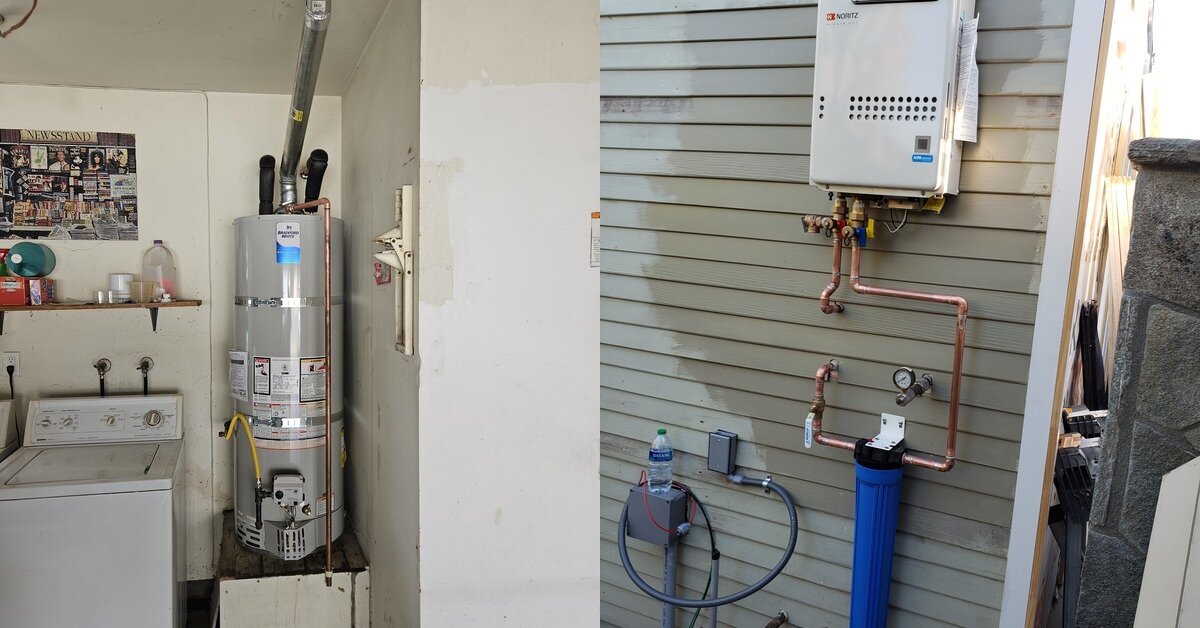
Water heater repair and replacement in Orange County is the work a licensed plumber does to fix or swap a home's water heater. In practice, that work covers new installations, repairs, code-required upgrades, and routine maintenance. The right next move depends on what type of unit you have, how old it is, what it is doing, and what the home around it looks like.
Key Takeaways
On this page
What service covers · Why it matters in Orange County · Warning signs and when to replace · Tank, tankless, or hybrid · Sizing · Code and permits · What drives the price · Brands and warranties · Maintenance · FAQ
You walk into the garage on a Monday morning and the floor squishes under your foot. Or the shower goes cold halfway through. Or the unit on the side of the house is flashing a code you have never seen. Either way, something is wrong with the water heater, and the next decision depends on a handful of questions you do not know how to answer yet. This page walks you through them.
A water heater repair or replacement call from Professional Plumbing covers the unit and everything that connects to it. That starts with replacement and new installation of tank, tankless, and hybrid heat pump units. It also includes repair work like control valves, thermocouples, heating elements on electric units, and thermostat replacements. Then there are the connections to water, gas, and vent, plus the pan underneath the tank that drains outside the home if the unit ever lets go.
Code work is part of the call too. Drip legs on the gas line, expansion tanks on the water supply, earthquake straps, water heater stands, and the temperature and pressure relief valve drain line all fall under it, along with new shutoff valves on water and gas. This page focuses on the residential side, because that is the call most homeowners are making when they search for water heater repair in Orange County.
Two local factors shape every water heater conversation in this county. Read them first, because together they explain almost everything that follows.
Hard water and sediment. The water here is hard. According to Municipal Water District of Orange County data, hardness across the service area runs 8 to 19 grains per gallon depending on city, and most of the county sits in the moderately to very hard range (MWDOC water quality). The minerals that make water hard, mostly calcium and magnesium, settle out when water heats. Over the years that sediment forms a hard-pack layer at the bottom of a tank that traps heat and slowly cooks the burner above it. As a result, most tanks here fail at 8 to 10 years, sometimes sooner.
The age of the homes. A meaningful share of Orange County homes were built between the late 1960s and the early 1990s, so many original installs are now on their third or fourth water heater. The platform the unit sits on, the venting, the gas line size, and the location were all sized for the first install. When the current homeowner upgrades, those underlying conditions become part of the job, sometimes in ways the homeowner does not expect. The geography here is Orange County overall, including unincorporated areas such as Rossmoor, Ladera Ranch, Coto de Caza, Cowan Heights, and North Tustin.
Most water heater repair calls in Orange County fall into a few buckets. In each one, start with what you notice, then read what it usually means.
On a tank, this usually means the pilot has gone out or the gas control valve is drifting. On electric, it is usually a tripped breaker, a failed element, or a thermostat. In short, no hot water is the single most common reason the phone rings, and the cause is rarely the whole unit.
You might see water on the garage floor, a wet drip pan, drips at the connections on top of the tank, or a slow stain at the base. About half the time, however, what looks like "the tank is leaking" turns out to be one of the flex connections on top. In other words, it is often a repair rather than a replacement.
A boiling or popping sound from a tank water heater is sediment hitting the burner. Most homeowners walk past it in the garage for months, though, without realizing what it is.
The standard "10 signs your water heater is dying" article gets one thing wrong. Most warning signs are maintenance signals, not failure signals. The same symptom can mean "flush this unit" on a five-year-old tank and "replace this unit" on an eleven-year-old tank. So read the sign and the age together.
Usually maintenance, especially on a tank under eight years old:
Usually the unit itself, and on an older tank the call to replace:
If the tank is in its eighth year or later and several maintenance signs show up together, replacement is usually the right answer. Repairing a five-year-old unit makes sense. Repairing a nine-year-old unit usually does not, because the parts and labor cost stacks against a tank that has only a year or two left.
The honest framing we use with the homeowner is the one we believe in. Above all, we want to solve the problem that is causing the issue, not just replace things.
The first move on any water heater repair call is a visual inspection. We check the vent connection at the top of the unit, seated and sealed. Next, we look at the temperature and pressure relief valve and its discharge line, routed to the outside of the building footprint as code requires. Then come the drip pan and earthquake straps, the gas and water connections at the top, and any staining or corrosion at the base. Finally, we note the condition of the platform under the unit. Anything that looks off gets written down before we touch anything.
On a no-hot-water call, the diagnosis path branches by unit type. On a tank, the suspects are the thermostat, the thermocouple, or the gas control valve. On electric, it comes down to the breaker, an element, or a thermostat.
On a leak call, every connection gets checked before any conclusion about the tank itself. In fact, many leaks turn out to be a flex line, a fitting, or a relief-valve discharge dripping into the pan. None of those mean a new water heater.
Some calls end with a small parts fix on a five-year-old unit, and the homeowner gets another four good years out of it. Other calls end with a recommendation to replace, because the math no longer works. On a tank past five years old, that math usually points to replacement once the parts cost becomes meaningful. A control valve, for example, is a substantial parts cost on its own, and the labor to put it in is not a small line either. So if the tank itself has only another year or two left, replacing the control valve means paying labor twice. You pay once for the valve now, then again for the tank in 2027 or 2028. As a result, the cost-aware answer is often to replace the unit and walk away with a fresh warranty.
The warranty math points the same way. On a tank water heater, the manufacturer warrants the steel tank for six years, but it covers the gas control valve and other component parts for a shorter period, and the labor to install a warranty part is generally paid only in the first year. Bradford White reimburses no labor at all, and Rheem provides a labor allowance only during the first year of ownership. On some brands the control valve itself is a one-year part. So when a gas control valve fails on a four- or five-year-old tank, the homeowner usually pays the labor, and sometimes the part, even though the tank is still under warranty. The chart further down, in the brands section, lays out the terms for each brand we install.
Three kinds of residential water heater make sense in Orange County: gas tank, gas tankless, and hybrid heat pump electric. Each one fits a different home, and the right choice depends on how many fixtures you run at once, whether you have gas at the location, and how long you plan to own the home.
Gas tank is the default for most homes here — straightforward to swap when the gas line and venting are already in place, and the least expensive up front. Gas tankless costs more to install but lasts more than 20 years and never runs out within its flow rate, which matters in larger households. Hybrid heat pump is the efficient answer when the home is on electric or moving off gas.
For the full comparison — sizing, condensing vs. non-condensing, cost of ownership, and the specific homes each one fits — see our tankless water heater guide.
Budgeting a tank swap instead? Our water heater installation cost in Orange County guide breaks down the real numbers, and real owner experiences with continuous-flow versus heat-pump electric water heaters are collected here too.
Tank sizing is where most homeowners guess. A 50-gallon tank gives a household roughly 35 to 40 gallons of usable hot water before the temperature drops, because a tank stratifies and the bottom layer turns cold first. The usable number is always lower than the number on the label.
A tankless unit removes the gallon question and replaces it with a flow-rate question: how many fixtures run hot at once. We size a tankless to the number of simultaneous fixtures a household actually uses.
A water heater swap in California is a permit-required job, and so is a relocation. A flush is not, and neither is an element or thermocouple replacement. When a swap happens, current code applies, so the job can trigger upgrades the old install never had:
A homeowner can pull the permit themselves rather than having us pull it. In many Orange County cities the permit is online and takes about 20 minutes. We do not mark up permits when we pull them; we pass the city fee through at cost.
We do not publish dollar amounts here, because Orange County prices are not representative of every region, and even within the county the same job varies by access, materials, code conditions, and brand. What is consistent is what drives the number, so you can read any quote, ours or a competitor's, and understand it:
Every estimate lists the variables that apply and the price for each, in writing before any repair work begins. Water heater replacement quotes often differ by hundreds or even thousands of dollars between companies. If you have gotten a quote for a job of $2,500 or more and would like a second opinion, we do them for free. The customer needs to have a written estimate from the other company. Call or ask for details.
Local rebates can offset the cost. Before you buy, check what your utility offers: SoCalGas has rebates on high-efficiency gas and tankless water heaters, and Southern California Edison offers rebates on heat-pump (electric) water heaters. We'll point you to the current programs that fit the unit you choose.
We sell Bradford White as our default tank brand. This is a preference, not a code requirement. The reason is warranty support, parts availability through wholesale, and our field experience with the units. One reality worth knowing: Bradford White is not sold at Home Depot, Lowe's, or any big-box retailer. Its distribution is wholesale-only, through plumbing supply houses to licensed installers (Bradford White wholesale policy). A homeowner cannot walk into a retail store and buy one, and the warranty terms differ between retail and wholesale channels. For tankless we install Noritz, Rinnai, and Navien — Noritz is our preferred tankless brand. See the full brand comparison and warranty terms in our tankless water heater guide. For hybrid heat pump we install Rheem and A.O. Smith.
Every water heater warranty runs three separate clocks: one for the tank or heat exchanger, one for the other parts, and one for the labor to install a warranty part. They rarely match, and the labor clock is almost always the short one.
| Brand and type | Tank or heat exchanger | Other parts | Labor |
|---|---|---|---|
| Bradford White (gas tank) | 6 years | 6 years | Not covered |
| Rheem (gas tank) | 6 years | 1 to 10 years, by model | First year only |
| A.O. Smith Voltex (hybrid) | 10 years | 10 years | First year only |
| Noritz (tankless), our preferred brand | 12 years (25 on the EZ Series) | 5 years | 1 year |
| Rinnai (tankless) | 15 years | 5 years | 1 year (5 if registered) |
| Navien (tankless) | 15 years | 5 years | 1 year |
Terms vary by model and registration, and manufacturers update them, so confirm the exact warranty for your unit. Current as of July 2026. Sources: Bradford White, Rheem, A.O. Smith, Rinnai, Navien, and Noritz.
Here are a few of the most common ones, with the actual answer.
It gives you hotter stored water, not more usable hot water. You then mix it with more cold water at the tap to get a usable temperature, so your overall capacity is roughly the same. The downside is that the tank now stores water at a higher temperature 24 hours a day, which costs more in energy. The bigger downside, however, is scald risk. The Consumer Product Safety Commission recommends 120 degrees Fahrenheit as the upper safe limit, and we set new units at about 125 degrees. We will not set higher than that when a homeowner asks. At 140 degrees, after all, an adult will third-degree burn in about six seconds, and a child can scald in less (CPSC tap water scald guidance). Family safety wins.
In theory, yes. In practice in Orange County, however, the anode is rarely worth replacing. The way most homes are built here, pulling the anode requires draining the tank, removing the unit from the platform, and pulling the rod through the top. You then put back a unit that has been disturbed and shortened in service life. So if the homeowner is doing the anode work as a planned step on a newer unit with easy access, it makes sense. On a typical Orange County install, it usually does not.
Sometimes. Sometimes not. We were called in once on a follow-up. The homeowner had passed on our quote and bought a water heater from someone else for two-thirds of our price. We asked permission to come look. As it turned out, the unit was used. The American Gas Association certification label had been removed. The manufacturer serial number had been removed too. It had not been inspected. In short, the cheap door-in price had bought them a used water heater with no warranty path, no certification, and no permit. The pattern is not universal. Still, pricing meaningfully below the market average for a permitted, code-compliant install is sometimes a signal worth checking.
A good water heater replacement does not stop at the install. On a tank, flush every six months starting when the unit is brand new. This is the part homeowners get wrong. Wait a year or two to begin, and the sediment has already cooked into a hard layer at the bottom where no flushing will pull it back out. That is why we schedule a quick 15-minute flush six months after every install, at no charge, and show you how to do it yourself if you would rather handle it next time. Homes with a whole-house softener can usually flush less often.
A tankless unit should be flushed once a year to keep scale out of the heat exchanger. The tankless installation page covers that schedule in detail. On both types, we inspect the temperature and pressure relief valve and its discharge routing on every visit, but we do not lift the test lever on a yearly schedule, because on older valves that is exactly what makes them start to leak afterward.
We took a service call from a Westminster customer who had water coming out of the garage. When we got there the garage was packed wall to wall, and we worked our way back to find the water heater in the corner. It had been leaking for a long time. The 18-inch platform under the unit had been built from wood at the original install, code-correct at the time, and by now the wood was all but gone. One side of the tank was sitting on a remnant 2x4, and the unit was leaning against the wall, held up by nothing but the bent copper lines on top of it. The home was a late-1960s build.
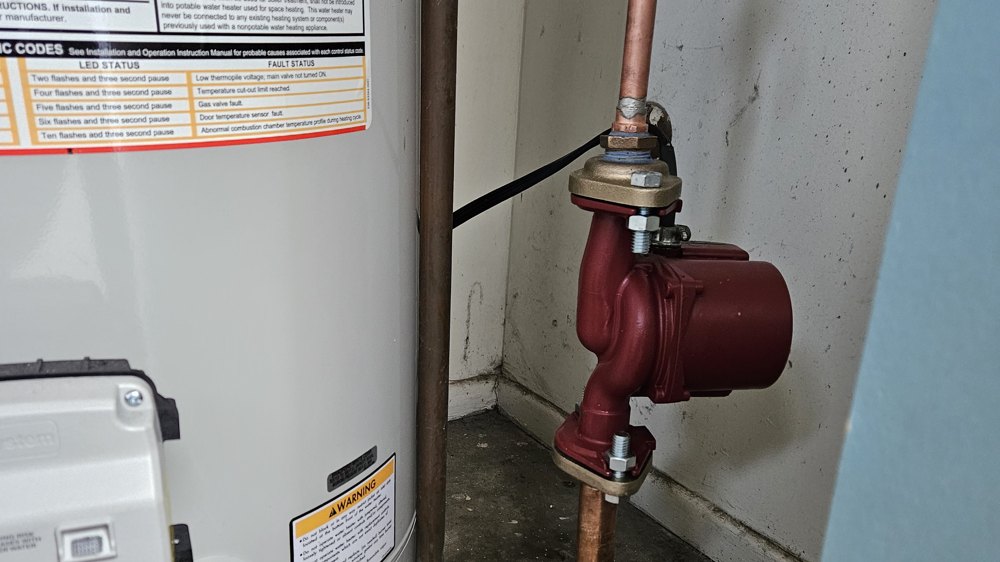
We drained the tank, rebuilt the platform in fresh lumber, replaced the bent copper, and installed a new unit with the current code work. The point of the story is not the dramatic find. It is the slow drip that ran for months before anyone noticed, which is exactly what the drip pan and the drain to the outside are there to prevent on a current-code install.
Here are two cases we have been called into that illustrate why the safety call-out in this article is not a formality.
We were doing a routine walk-through plumbing inspection on a home in Orange County. In the kitchen, the homeowners had a water heater installed inside a cabinet next to the pantry. When we looked at the install, the vent connector at the top of the unit was lying loose. It had either fallen off or been disconnected at some point. As a result, every time the water heater fired, combustion gases including carbon monoxide vented directly into the kitchen instead of up the flue. The family had not noticed, because they kept the windows open. We will not write down what a year of unnoticed carbon monoxide exposure can do to a household. We will say this: a vent connection check on a routine inspection is one of the best returns on plumbing maintenance a homeowner can buy.
A homeowner called us after he had been burned. The temperature and pressure relief valve on his water heater had opened, which is what it is designed to do when pressure or temperature rises out of the safe range. The valve, however, had no discharge line on it at all. There was no pipe to carry the water anywhere. So when the valve opened, scalding water blew out everywhere, right there at the unit. He reached up to shut the water off, got sprayed, and burned his hand and arm before he could close the valve. He recovered, but it could have been worse. In short, the discharge routing to the outside of the building is not a paperwork requirement. It is the difference between a contained problem and a personal injury.
The CPC sections that require T&P discharge routing to the outside, 505.6 and 608.5, exist because of cases like this. We follow them on every install. And when an existing install does not meet them, we make sure the homeowner understands why we are quoting the routing work as part of the job.
A tank water heater in Orange County typically lasts 8 to 10 years, sometimes less. The county's hard water shortens that lifespan compared with softer-water regions. Flushing every four to six months extends the unit, but it does not stop the tank itself from eventually failing.
No hot water in the morning is usually a single failed part, not the whole water heater. On a gas tank it is most often a pilot that went out or a failing gas control valve; on an electric unit, a tripped breaker, element, or thermostat. It is worth a service call before assuming replacement.
Replacing a water heater in Orange County requires a permit, as does a relocation. Repairs such as a thermocouple, heating element, or thermostat replacement do not require a permit, and neither does a flush.
You probably need an expansion tank if your home has a pressure regulator, check valve, or backflow preventer at the meter, which makes it a closed system. California Plumbing Code 608.3 requires one on closed systems, and most Orange County homes are closed systems today.
Set your water heater to about 120 degrees Fahrenheit, the upper safe limit the Consumer Product Safety Commission recommends. We set new installs at about 125 degrees and will not go higher when asked, because of scald risk to children and older adults. A higher setting only gives hotter stored water, not more usable hot water.
For most two-bathroom Orange County homes, a 50-gallon tank is the right size and the one we install most. A 40-gallon tank suits a one-bathroom home, while larger homes, a soaking tub, or several back-to-back showers are better served by a 75-gallon tank or a tankless unit. A 50-gallon tank delivers only about 35 to 40 gallons of usable hot water before the temperature drops.
Bradford White and the brands sold at Home Depot are different products with different distribution channels. Bradford White sells only through wholesale plumbing distribution to licensed installers, while retail-channel brands sell to anyone. The wholesale channel typically comes with a clearer path for warranty service when a unit fails.
Tankless makes sense for larger households and long-term homeowners — it lasts more than 20 years and never runs out of hot water within its flow rate. It's usually not worth it for smaller homes with an easy tank swap. Our tankless water heater guide and selector walk through whether it fits your home.
We service water heaters throughout Orange County. Pick the office or service area nearest you for local details:
If you would like us to come out and take a look, we are available 24 hours a day, every day of the year. Estimates are free during normal business hours, Monday through Saturday, for work we can see and price on site. If finding the problem requires diagnostic tools or testing, the diagnostic work is quoted before we begin, and the repair is quoted in writing before any repair work starts. After hours and on Sundays, the visit is at overtime rates. We give a two-hour window and call when the truck is on the way. If your water heater turns out to need something simple, like a thermocouple or a flush, we will tell you that. If it is a failing tank at end of life or a venting problem that is a carbon monoxide risk, we will walk you through the options and the cost on each one.
If you smell gas or feel sick near a gas water heater, stop and act first.
If you can smell gas in your home, or if anyone has a headache, dizziness, nausea, or confusion near a gas-burning water heater, take these actions in order.
A separate water heater hazard is scalding. A water heater set above 120 degrees Fahrenheit can produce a third-degree burn in seconds, particularly to children and older adults. The U.S. Consumer Product Safety Commission recommends 120 degrees as the upper safe limit.
A water heater is one system in a house full of plumbing. We also handle drains and sewers, slab leak repair, and fixture installation. When you are ready, request a quote or contact us.

About the author
William J. Horsky Jr. owns Professional Plumbing, Inc. He founded the company in Orange County in 1985 and has run more than 36,900 plumbing jobs across the area since then. The company has been licensed by the California Contractors State License Board since 1987 (CSLB license number 517514, classification C-36, current and active), incorporated as Professional Plumbing, Inc. in 2001, and is a 2026 BBB Torch Awards for Ethics finalist. It operates from offices in Fountain Valley, Garden Grove, Huntington Beach, Costa Mesa, and Newport Beach, and serves homeowners and businesses across Orange County.
This page was updated on October 12, 2026.
Have a question?
If you are trying to understand a plumbing problem at your home, weighing your options, or working through a DIY project, you are welcome to call. The number is (714) 964-3519.
Day or night, you'll reach me or my sister Liz. After hours and it can wait? Feel free to book online anytime.
There is no obligation to schedule service. We like talking to people in our community, and sometimes a phone call answers what an article cannot.
William J. Horsky Jr.
Owner, Professional Plumbing, Inc.
Serving Orange County since 1985.
Jon came over to disconnect a washer and dryer in my house. He was on time, very professional and such a nice person. Jay the owne…
These 2 were fast, efficient, clean, friendly and taught me a lot about old plumbing habits that I've been doing totally wrong. Ni…

These 2 were fast, efficient, clean, friendly and taught me a lot about old plumbing habits that I've been doing totally wrong. Ni…
Always on time and polite.
Great service!! and I always get a good tip too to help keep my drains moving!
Professional Plumbing is worth their weight in Gold. Had a previous current water bill showing an increase in high water usage in …
A special shout out to Darin and Oscar for their honest, knowledgeable and kind service concerning what we thought was a slab leak…
Nick, Oscar, Dustin and Vince are the best. We trust them with all our plumbing needs, residential and commercial.
We have had many different plumbers do work for us over the years. That has all come to an end. We are sticking with Professional …
I work for Meadowlark Golf Club and when I called, Jay, the owner, and his entire team were fantastic! I ended up calling three da…
I had spoken to Nick the regional manager, and he was very honest about what we were looking at for our slab leak. I think they're…
I have been using them for many years, they are an honest company and I never felt they were out to get me, always explained the p…
I have used Professional Plumbing several times, always with excellent results. They are my go to plumbers. They are friendly, pun…
We've relied on Professional Plumbing for all our plumbing installations and repairs for over ten years and they've never let us d…
Jay and his team are highly professional and easy to work with.
Great experience all around. Responsive to emails and texts and did an excellent job installing our Seismic shutoff valve.
Nick Haas is an amazing plumber. He has worked on my houses for about 26 years, and I have always been impressed by his profession…
Have always been very happy with work done by Professional Plumbing, both when we were remodeling as well as any subsequent repair…

Prompt, professional, and very reasonable. Very happy with their service!
Professional and respectful.
Every once in a blue moon you meet someone who renews your faith in humanity. I had an emergency leak in my bathroom tonight. My p…
Nick and his colleague installed a new angle stop and feedline. They ensured I knew where the main shut-off was. They did an excel…
I needed a fix to my shower faucet. A pro arrived with everything needed to complete the job. Chris advised in detail and got to w…
Chris Kirsten was outstanding. He helped me with replacing a toilet and getting an old shower to work again! He went above and bey…
We always call Professional Plumbing when we have a problem. They are knowledgeable, reasonably priced, prompt and respectful of o…
I called in near panic as the water line into the pool broke and I couldn't turn the main water source off myself. I called a plac…
Very friendly and patient plumbers who, as other reviewers have stated, know things that most plumbers don't. They let me watch an…
Absolutely the most professional service! They not only did a great job but cleaned up as well. They worked as if my home were the…

Chris is a top-notch professional. Everything about my repair was better than I expected. I noticed the leak right at end of day, …