


Drainage Service in Orange County: Causes, Signs, and Repair Options
By William Horsky · Updated May 26, 2026

Stop reading and act if sewage is backing up into your home right now
If active sewage is coming up through a tub, shower, floor drain, or toilet, stop using all water in the home, including washing machines and dishwashers. Sewage water carries bacteria that can make people in the home sick. Keep children and pets away from the affected area until the line is cleared and cleanup begins. Call us at (714) 964-3519 to get a plumber on the way.
Once the immediate situation is handled, the rest of this article walks through what drainage service covers, how to read the signs, and how to evaluate a quote.
What this article covers
You step into the kitchen, fill a pot at the sink, and notice the water is taking longer to drain than it used to. Or you turn on the shower in the bathroom and hear a strange gurgle from the toilet across the room. Or you walk into the back yard and find a soft, suspiciously green patch of grass over the path your sewer line takes to the street.
Drainage service. Drainage service is the work a plumber does to keep water and waste moving away from your home, fixture by fixture, all the way out to the connection with the city sewer main. It covers everything inside the home (sink drains, tub and shower drains, toilet drains, laundry drains, the branch lines that tie them together) and everything outside (yard drains, courtyard drains, roof drains, deck drains, the vent stacks through the roof, and the lateral sewer line that runs from the home to the city tap).
In Orange County, drainage problems usually trace back to one of three sources: a clog inside the home, root intrusion in the lateral, or aging pipe material that has finally reached the end of its service life.
Key takeaways
- Tree-root intrusion causes roughly 70 to 80 percent of mainline sewer failures in our service area.
- Vitrified clay sewer pipe ships in 4-, 5-, or 6-foot sections, and the joints between them are where root intrusion gets in.
- A toilet that gurgles when you run a bathroom sink or shower is signaling a mainline problem, not a fixture problem.
- Trenchless lining is rarely the right call in Orange County outside of expensive hardscape situations.
- If you have been quoted $2,500 or more for drain work, it is time to get a free second opinion.
Why drainage problems look the way they do in Orange County
Orange County has a few environmental and historical patterns that shape what we find in the ground. Most of the county sits on clay-heavy soil that expands when wet and contracts when dry. Over decades, that seasonal movement opens the joints in older clay sewer laterals, and every open joint is a potential entry point for tree roots.
Vitrified clay sewer pipe ships in 4-, 5-, or 6-foot sections. A typical Orange County residential lateral runs 30 to 50 feet from the home to the city tap, which puts 5 to 13 joints in the line, every one a potential root entry point. The math works against the homeowner over time.
Housing eras and pipe materials
Housing eras matter as well. Homes built before 1965 in Orange County typically have cast iron drain piping inside and a clay lateral running out to the street. The post-World War II tract neighborhoods built from the late 1940s through the early 1970s often have Orangeburg laterals, a bituminous-fiber pipe made of wood pulp sealed with coal-tar pitch. Orangeburg was an expedient material at the time and is now well past its expected service life.
Clay continued to be installed on Orange County residential laterals into the 1990s and in some areas later than that, so a home built well after 1965 can still have a clay lateral in the ground. Homes built from the 1970s onward typically have ABS drain piping inside the home, and ABS is also the common material for residential laterals on newer Orange County construction.
Local oddities worth knowing
In parts of southern Huntington Beach, we sometimes find copper drain-waste-vent piping where most of the county would have cast iron or ABS. The joints on copper DWV have to be soldered together, and the closet flanges that connect a toilet to a copper drain are brass, not the plastic or ferrous flanges used elsewhere. The repair work on those homes runs slower and the materials cost more than a standard drain repair, so the diagnostic playbook is a little different from the start.
Along the coastal zones near Newport Beach and Huntington Beach, sandy soil shifts more than the clay soil inland, and heavy rains can cause minor settling that creates low spots in the line. We call those low spots bellies, and they trap solids over time even when the rest of the line is in good shape.
Pipe materials commonly found in Orange County homes
Many Orange County homes contain more than one pipe material in a single drainage system, the result of past partial repairs, additions, or remodels. The next section is the one to read if your home is in that category.
Why transition fittings matter on older and remodeled homes
Each transition between two pipe materials in a drainage system needs a specific fitting designed for that pair. The wrong fitting on a transition is one of the most common installation failures we find on camera inspections, and it is the one most often missed by inspectors because the connection often holds for months before it fails.
A few of the transitions we work with regularly in Orange County:
- Vitrified clay to cast iron, ABS, or PVC. Vitrified clay sewer pipe has a significantly larger outside diameter than the same nominal inside diameter on cast iron or plastic. The two cannot be slip-fit together. A purpose-built transition coupling with the right sleeve and clamps handles the diameter mismatch and seals the joint.
- ABS plastic to cast iron. Mechanical no-hub couplings with stainless steel bands, or specialty transition fittings, handle this pair. The wrong fitting either fails to seal or stresses the plastic over time.
- Copper drain-waste-vent to anything else. Copper DWV transitions require a dielectric or purpose-built transition fitting to avoid galvanic corrosion at the connection between copper and ferrous metal, and to handle the diameter difference between copper and plastic or cast iron.
- ABS plastic to PVC plastic. This is the most common error we see on DIY work and on unlicensed installations. The two plastics need a specific transition cement formulated to bond both materials. Using straight ABS solvent or straight PVC solvent produces a joint that looks fine for months and then leaks. The right product is a green-labeled ABS-to-PVC transition cement, which the plumber should be able to name on sight.
A homeowner does not need to memorize the fittings. The point is that if your home has a multi-material drainage system, the cost and the time on any drainage repair go up because the right transition fittings have to be on the truck before the work starts. When you are reviewing a quote, a plumber who can name the specific transition fittings the job requires is a plumber who has taken the time to look at your system.
Weather is mostly a non-factor for drainage in Orange County. We do not have the freeze-thaw cycles that wreck pipes in other parts of the country, and we do not have the heavy seasonal soil swings that strain plastic pipe in colder regions. Most of the failures we see trace back to three causes: roots, age, or poor original installation.
The five most common drainage problems we see in Orange County homes
Below are the problems that bring people to call us, ordered by frequency. In short, here is what we see most often on a drainage call.
1. A stoppage or clog inside the home
Typically, the most common drainage call is a single fixture that has stopped draining or is draining slowly.
Bathroom sink slow to drain? Usually hair built up around the pop-up assembly, which we pull and clean in a few minutes.
Shower drain slow? Often the same story: hair built up in the strainer or in the first few feet of horizontal pipe that runs from the P-trap toward the main drain. In fact, the short vertical drop right under the strainer is rarely the problem. Instead, the slowdown is downstream where the line runs flat.
Kitchen sink that is slow or that backs up when the dishwasher runs? Usually grease and food solids built up in the trap or the branch line. On older homes, the situation is often complicated by an aging galvanized pipe coming out of the P-trap. Over the years, food particles and grease build up on the pipe walls and leave most of the inside diameter blocked.
Fortunately, these are the easy ones. Most clear with a cable run and the right approach for the fixture.
2. Root intrusion in the mainline
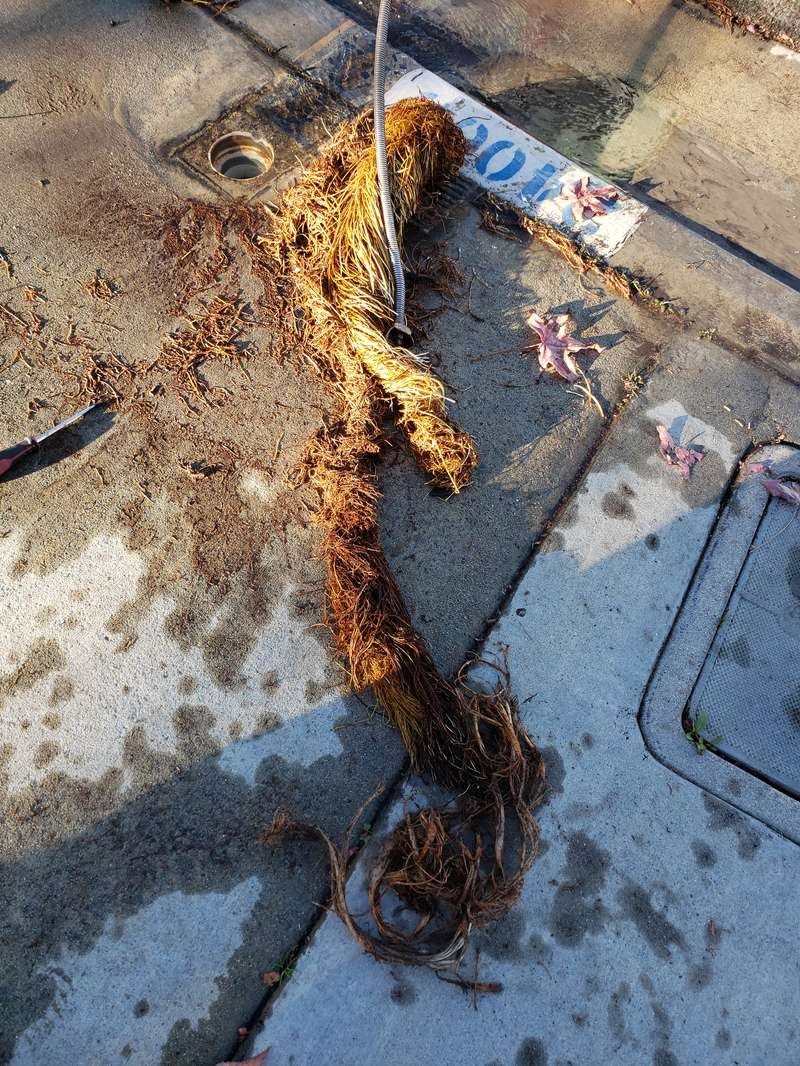
This is the most common cause of a recurring sewer problem. As a result, it brings homeowners back every six to twelve months until the line gets repaired. Tree roots are drawn to the moisture and nutrients inside a sewer pipe. Once a root finds a hairline crack or an open clay joint, it grows fast. In addition, the bigger the root gets in diameter, the more it pushes the pipe apart from the outside.
In Orange County, the two trees that cause the most trouble are ficus and palm. Ficus roots are aggressive, and they spread far. Palm roots, on the other hand, come in dense, woven balls. In fact, they can dull a chainsaw if you try to cut them.
3. A cracked or broken clay or cast iron pipe
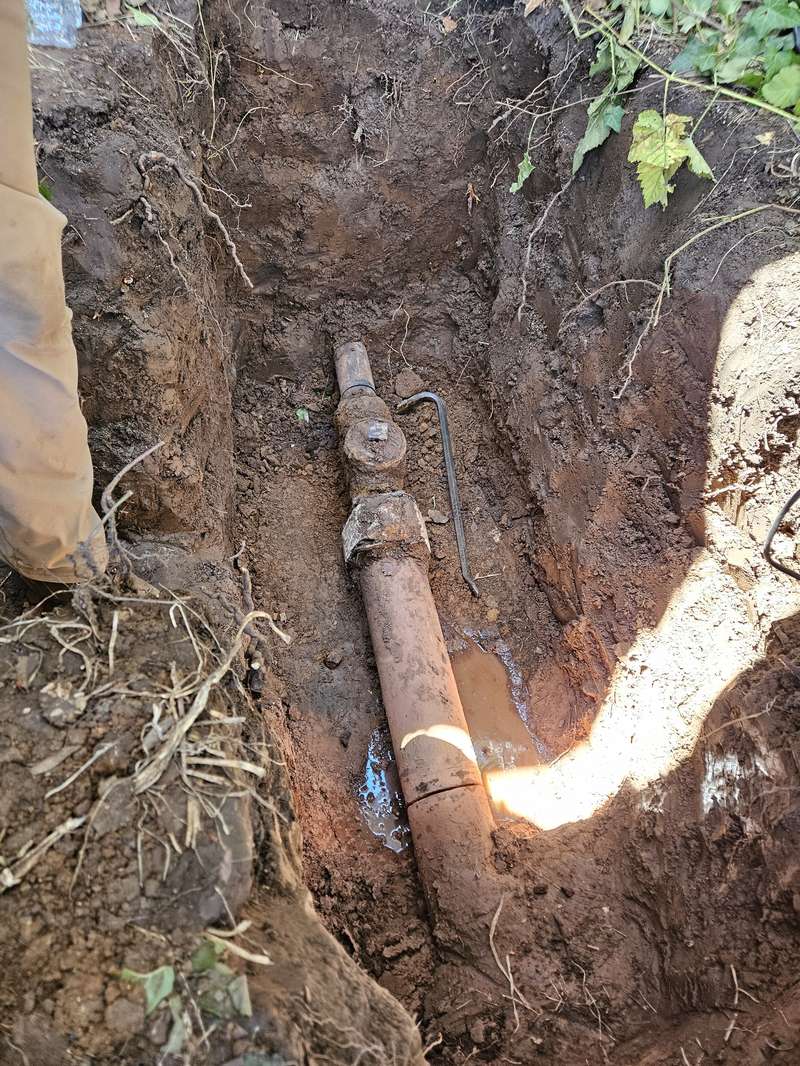
Clay pipe cracks where the soil has moved over the years. Cast iron pipe, on the other hand, rusts from the inside out. On older homes, the bottom of the pipe can rot away entirely. The top half stays intact, but the bottom opens to the surrounding soil. Either way, the result is solids hanging up at the break. In addition, water seeps out into the surrounding ground.
Typically, we find these breaks on the camera when we run a diagnostic inspection. For a small spot crack on a line that is otherwise sound, we repair with a spot dig and a new section of pipe. However, a line with breaks in multiple places, or a cast iron line where the bottom is gone, gets replaced.
4. An offset or step in the line
When one section of clay pipe settles into the soil and the next section does not, the joint between them ends up out of alignment. As a result, water and solids hit the step and slow down. In fact, we see this often enough on older laterals to give it a name in the shop: a step. Roots love steps because the open offset gives them somewhere easy to grow.
5. A belly or low spot
First, the pipe sags below grade in one section. Then water pools in the sag, and solids settle out of the standing water. Bellies are most common near the coast where the soil is sandier. In those areas, heavy rains can cause minor settling under a line that was installed level on day one. Fortunately, we can identify a belly on the camera. The fix is to dig up that section and reset the pipe at the correct slope.
How we diagnose a drainage problem
When the call comes in, we ask a few questions to understand what is happening. The answers determine what we bring to the job. From there, the diagnosis runs in roughly this order.
- Verify the stoppage and locate it. We run water at the affected fixture and time how long it takes before it backs up or before a toilet down the line gurgles. That tells us roughly how far the stoppage is from the fixture. If water has been standing for a while, that is usually a hard stoppage and the cable work will take longer.
- Pull a cleanout cap if one is accessible. Two-way cleanouts let us run a cable both directions, into the home or out to the street, without pulling a toilet. If the home does not have a cleanout, we work through the lowest accessible fixture or pull a toilet.
- Match the cable to the pipe. Each of our trucks carries five different cable types and head sizes for different pipe diameters and stoppage types. A small home cable for a bathroom sink is the wrong tool for a 4-inch mainline, and vice versa.
- Run a sewer camera if the problem is the mainline. A camera inspection is the only way to see what is in the pipe and what shape it is in. We can identify roots, cracks, offsets, steps, bellies, and missing pipe material on the screen, and we can locate any of those features above ground so we know exactly where to dig if a repair is needed.
Importantly, we do not start with a recommendation to replace your sewer line. Instead, we start with clearing the stoppage and seeing what the pipe looks like inside. The repair decision comes from what the camera shows, not from a guess.
Repair options for drains inside the home
For most inside-the-home drain problems, the right tool is a cable run from a cleanout or the affected fixture. In most cases, a skilled cable operator clears a stoppage the same day. As a result, the line is back to draining normally before the truck leaves.
By contrast, hydrojetting is the right tool for a different set of problems. For example, commercial buildings with heavy grease loads benefit from a periodic jet. So do large-diameter restaurant kitchen drains and a few residential kitchens that cook with a lot of oil. Specifically, the high-pressure water cleans the full circumference of the pipe, which a cable cannot do. For most residential clogs, however, a properly run cable does the same job at lower cost and lower risk to older pipe.
A note on jetters and roots. Jetters are sometimes marketed as a way to cut tree roots. However, in our field experience, a jetter clears the soft material around the roots but does not reliably cut the roots themselves. In fact, we have not had good luck with jetters as a root solution. On an older clay line, a jetter can even accelerate damage by opening joints further. For a line with root intrusion, the honest answer is that the roots are coming back until the pipe is repaired.
From a Costa Mesa job, in William's voice
A few years back we got a call from a homeowner in Costa Mesa who had a manufactured home set on a raised concrete foundation. He kept seeing water underneath the house and couldn't figure out where it was coming from. My guys went out, crawled under, found water, dried it out and pumped it out. About a week later he called us back. Now there were three to four inches of water under there.
So we went back, turned on every fixture in the house, and crawled under again. As we worked our way toward the front of the home, where the entrance wasn't, the water was deep enough that we were going through mosquitoes living in it on the way. At the front of the house, we found water coming up out of the ground at one spot. The sewer line was plugged further out, and every flush and every drain in that home had been draining into the dirt underneath the slab.
When we dug it up, we found a piece of clay sewer pipe running underneath the foundation that wasn't supposed to be there. The Uniform Plumbing Code doesn't allow clay drain pipe inside the foundation of a house, but the builder had run it there anyway. While the foundation concrete was being poured, someone had driven a wooden form stake right through the clay pipe and left it. Years of waste had been escaping through that hole into the dirt under the home.
We pulled out the floor in the back of the house, dug down, took out the clay line, and replaced the run with code-compliant pipe routed where it should have been from the start. The lesson on this one is that when something's wrong with the drainage and the obvious answer doesn't explain it, the answer's usually somewhere harder to see. A thorough diagnosis is worth what it costs.
Repair options for the sewer mainline
When a sewer mainline needs more than a cable run, four options are on the table. Importantly, the right choice depends on what the camera shows. In addition, it depends on what the homeowner can access in the yard.
Why we prefer replacement over trenchless lining
Our default is spot repair when one is appropriate. For lines that have reached the end of their life as a whole, the answer is full replacement. We are not enthusiastic about trenchless lining as a routine choice for residential laterals in Orange County. The lining process reduces the inside diameter of the pipe. On corners and tees, the liner can also bunch up the way a sock bunches over the top of a foot. As a result, the effective diameter shrinks further. A lined pipe also does nothing for a belly, because the liner follows the shape of the existing pipe.
A lined pipe is not permanent against roots either. Roots can deform the resin over time as they grow, and when that happens the line ends up with both the original problem and a more complicated repair the second time.
In addition, there is an ongoing maintenance cost consequence to lining a pipe. Once a pipe is lined, future drain clearings have to be done with hydrojetting instead of cabling. Specifically, a cable damages the resin lining. As a result, every future stoppage on a lined line costs more to clear than it would have on the original pipe.
When trenchless or pipe bursting IS the right call
Specifically, we recommend trenchless or pipe bursting in one situation. The line runs under a recently installed driveway, an expensive hardscape feature, or a structural feature that would be disproportionately costly to remove. In those cases, the comparison is no longer “lining versus open trench” in isolation. Instead, it becomes “lining versus open trench plus driveway replacement.” Naturally, that changes the math.
For most other situations, a full replacement of a typical Orange County residential sewer lateral is often comparable in cost to a trenchless lining of the same line. In addition, the replacement leaves the homeowner with a brand-new pipe at proper slope. Ultimately, the choice is not as one-sided as the marketing around trenchless suggests.
Finally, one more thing worth a phone call before a homeowner signs a trenchless lining contract. Check with the individual city’s building or public works department on the current policy for CIPP lining on residential laterals. Inspection requirements, accepted products, and the permit pathway for trenchless work can change. In addition, the city you are in may have specific guidance about whether a particular lining product is on its accepted list. Five minutes on the phone with the city is worth more than the marketing brochure from any vendor.
When to clear, when to spot-repair, when to fully replace
In practice, the decision logic on a mainline goes like this:
- If the cable clears the stoppage and the camera shows a line in reasonable shape, we are done. Schedule the line for a follow-up if the cause was root intrusion and the homeowner is not ready to replace.
- If the camera shows a single break, offset, or crack on an otherwise sound line, the right move is a spot repair with a two-way cleanout installed at the dig.
- If the camera shows multiple breaks, a long root-intrusion run, a belly, or a cast iron line where the bottom has rotted away, the right move is a full open-trench replacement.
- If a full replacement is the right move but expensive hardscape is in the way, trenchless lining or pipe bursting comes into the conversation as a secondary option, with the trade-offs of each explained in writing.
Importantly, we do not recommend a full sewer replacement to a homeowner whose camera shows a line in working shape. If the line works, the line works.
From a mid-1990s job in Huntington Beach, in William's voice
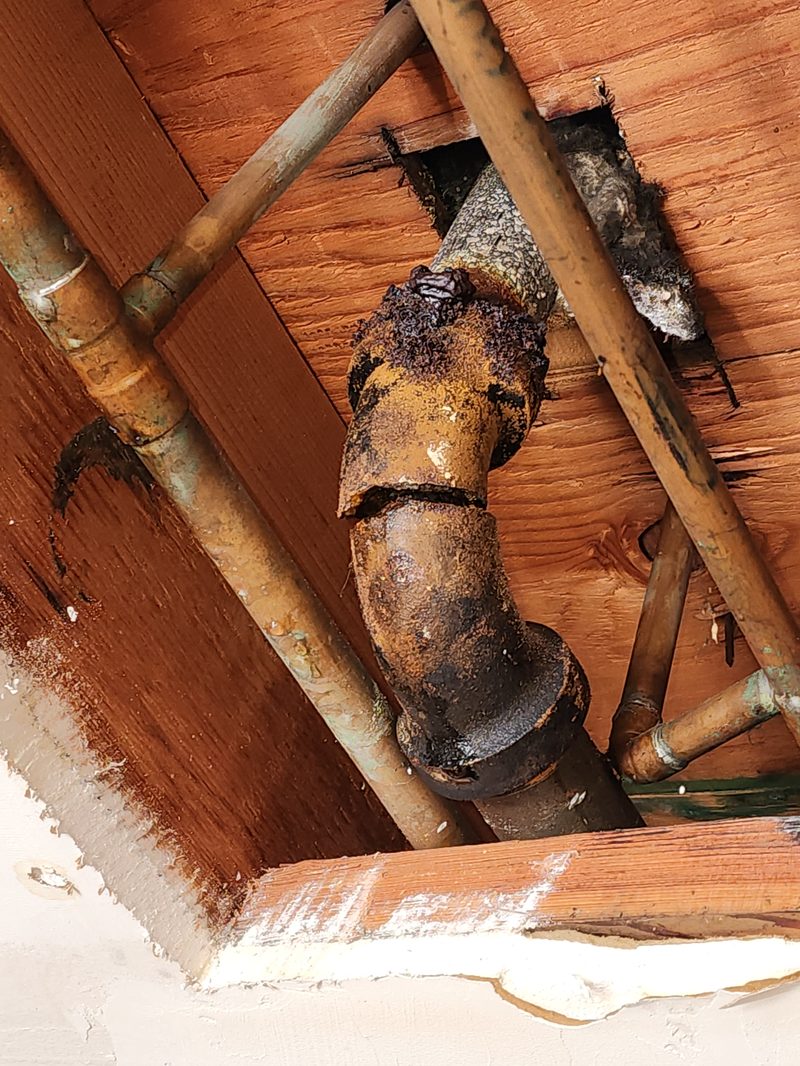
Another job we had was on a home in Huntington Beach with a recurring stoppage on the upstairs line of an addition. The addition itself had been built in the early 1990s by someone else, and we were called in two or three years after that to figure out why the line kept backing up. Upstairs lines don't usually clog the way that one was clogging. A toilet stoppage we expect. A single sink stoppage we expect. A full upstairs line that backs up over and over, with the water draining off and the solids hanging up behind it, is unusual enough that we had to open the ceiling to see what was going on.
When we did, my guys found that every directional fitting in the run had been installed backwards. They're directional fittings, meaning the geometry inside the fitting is designed to send solids one direction with the water. Rotated 180 degrees, the fittings were pushing the solids back up the line while the water drained right past them. The water made it through, the solids didn't, and that line would back up cleanly every time we cleared it because the underlying installation was sending material the wrong way.
We did not handle the repair on this one. The situation became a legal matter that ran past our scope, and our role was strictly the diagnostic: opening the wall, documenting what we'd found, and explaining how that installation was causing the recurring stoppage. The scary part of it is that the city's building department had signed off on the original work when the addition was inspected. For any homeowner reading this, the takeaway is that an inspection sign-off isn't the same as proper work. When a stoppage is repeating in a pattern that doesn't match a normal clog, the right move is to open it up and look at the work, not to keep snaking it.
The case for installing a cleanout
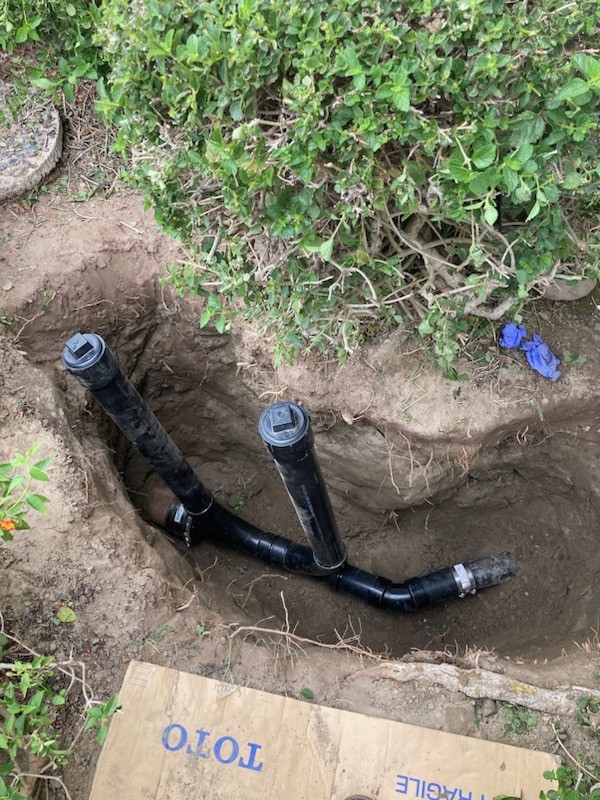
Many older homes do not have an accessible two-way cleanout on the sewer lateral. If yours is one of them, your next drain job will cost more than it should. So will the one after that. Specifically, a cleanout is a vertical riser off the lateral with a cap at grade. It lets a plumber cable both directions: into the home and out to the street. As a result, no toilet has to be pulled and no wall has to be opened.
The upfront cost of installing a cleanout is real. However, it pays back the first time we use it instead of pulling a toilet. On every spot repair or full replacement we do, we install a two-way cleanout as part of the job if one is not already in place. In fact, that is one of the most valuable pieces of work the homeowner takes away from the visit, separate from the repair itself.
Why we do not snake from rooftops
Some companies will snake a sewer line from the roof vent stack when no cleanout is available. However, our insurance does not allow our crews to do drain work from rooftops. The reasons are real on both sides. First, there is a workers’ compensation claim if a technician slips. Second, there is a liability claim if the weight of a drain machine damages the roof. In short, nobody wants a roof leak after they call a plumber. When access is the issue, the cleanout install is the right answer. As a result, we include it in the quote rather than working from above.
What drainage work costs
Drainage pricing varies more than most plumbing categories. Specifically, the work depends so heavily on what the camera shows and what kind of access the line has. For example, a bathroom sink clog and a full sewer replacement are both drainage service, yet they sit at opposite ends of the cost range.
Every drainage job we quote includes a free on-site evaluation when the work is something we can see and price on site. However, when the diagnosis requires the camera or a cleanout pull, we quote the diagnostic work before we begin. Then we quote the repair itself in writing before any repair work starts. In the written quote, the variables that affect the price are named so you can see what is driving the number.
Free second opinion on quotes of $2,500 or more
If you have gotten a quote for a job of $2,500 or more and would like a second opinion, we do them for free. The customer needs to have a written estimate from the other company. Call or ask for details.
This applies often on drainage work. Trenchless lining quotes, in particular, have a way of landing in the high four figures or low five figures. In many cases, a different approach would work for a fraction of the cost. A free second opinion on a $15,000 lining quote is one of the highest-leverage phone calls a homeowner can make.
Common misconceptions about drains and sewer lines
A few myths show up over and over on calls. Unfortunately, they cost homeowners real money. The honest versions are below.
Chemical drain cleaners
They damage pipes more than they help drains. Sulfuric-acid-based products, in particular, have a long history of eating the inside of cast iron. They also damage seals and gaskets along the way. We have seen homes where a chemical drain cleaner cleared the immediate clog and then required a much larger repair within a year. The pipe could not handle the chemistry. If the drain will not clear with a plunger, call a plumber before reaching for a chemical product.
Flushable wipes, baby wipes, and feminine hygiene products
None of these are flushable, regardless of what the package says. They do not break down the way toilet paper does. In addition, they do not travel cleanly through the system. In the trade, we call wipes “sewer rats.” They lay out long in the pipe, and the trailing tail of each one catches on any rough spot inside. As more material snags behind it, the stoppage builds. For all of these reasons, toilet paper is the only paper product that belongs in a toilet.
Snaking a line with root intrusion
It will not fix the problem. A cable clears the immediate stoppage by cutting the roots inside the pipe right now. However, the roots grow back through the same opening. In addition, as they grow bigger in diameter, they push the pipe further apart. The honest fix for root intrusion is the pipe repair, not annual snaking. In the meantime, an annual snake is a reasonable maintenance step for a homeowner who is not ready financially for the full repair.
Lining a pipe to keep roots out
It does not work forever. Roots can deform the resin over time as they grow. In addition, a lined pipe has a smaller inside diameter than the original pipe did. As a result, any future clog is more likely.
Root killers down the toilet
When you flush a foaming root killer down the toilet, the next shower or load of laundry washes most of it past the roots and into the city main. As a result, the chemical does not have enough contact time with the roots to do real damage. The same chemical applied directly to an outdoor yard drain or pool drain can have some effect. In those drains, the water flow is slow enough for the chemical to make contact. In a residential mainline, however, the chemical is mostly money down the drain.
Hot water and the garbage disposal
Running hot water while you run the garbage disposal melts kitchen grease. The melted grease flows down the line and cools. As it cools, it forms a hard layer on the inside of the pipe. Cold water, in contrast, keeps the grease in solid pieces that move down the line. Use cold water with the disposal.
City sewer lateral responsibility varies by city
One question that comes up on most mainline jobs: who is responsible for the section of pipe between the home and the city sewer main? The answer varies city by city in Orange County. In addition, the variation can affect a homeowner’s out-of-pocket cost. On every mainline job where a parkway tree might be involved, we call the relevant city’s public works department first. That way, we are not charging a homeowner for work the city would cover.
Huntington Beach
The city operates a Sewer Lateral Program. Specifically, when a homeowner reports a problem, Public Works requires the lateral to be cleaned and videoed first by a qualified contractor at the homeowner’s initial cost.
If the city arborist (the tree expert on the city’s public works staff) decides that a parkway tree must be removed, the city checks whether the issue falls within city responsibility. When it does, the city initiates the repairs at city cost. In addition, the city reimburses the homeowner for the cost of the video. Notably, slip lining is one of the options the city will use when the parkway tree can be preserved per the arborist’s review.
For more detail, the HB program is documented on the City of Huntington Beach Sewer Lateral Program page. In addition, the Public Works Utilities Division can be reached at 714-536-5921.
Fountain Valley
Notably, the city places the entire lateral on the homeowner. Per Fountain Valley Municipal Code Chapter 14.36, the property owner is responsible for the sewer lateral all the way to the junction with the sewer main. In addition, the lateral must be kept in a safe and sanitary condition. The city, in turn, is responsible for keeping the main itself clear.
Newport Beach
By contrast, the city takes responsibility for the sewer lateral out to the curb line. Past the curb, the homeowner side ends and the city’s wastewater system begins. The Newport Beach Wastewater Division handles main and lateral cleaning, blockage and odor response, and breaks and repairs on its side. Before scheduling any major lateral work in Newport Beach, call Public Works at 949-644-3011. Ask whether the work falls on the city side or the homeowner side. Policy on the boundary case (a problem right at the curb) can vary.
In short, before you schedule any lateral work, especially work that involves a parkway tree or work near the curb, call your city’s public works department. In many cases, the five-minute phone call saves the homeowner thousands of dollars.
Permits and code
Importantly, California does not require a permit for every drainage call. The line is in the plumbing code. Specifically, stopping a leak in a drain, water, soil, waste, or vent pipe does not require a permit. However, replacing a concealed defective trap, drain pipe, waste pipe, or vent pipe with new material does require a permit. The code treats that replacement as new work (California Plumbing Code, Chapter 7 Sanitary Drainage).
In practice, this means a same-day drain clearing or a cleanout cap replacement is not a permitted job. However, a sewer line spot repair, a full sewer line replacement, and a trenchless lining are all permitted work. Any other job that cuts out and replaces pipe in the ground is also permitted. In each case, a licensed contractor pulls the permit before the work begins.
When the work is permitted, the homeowner receives the permit number, the inspection schedule, and the final sign-off as part of the job documentation. In addition, that paperwork matters for resale and for insurance. For that reason, it is part of every permitted job we do.
From a 2014 job in Garden Grove, in William's voice
A homeowner in Garden Grove called us one evening in 2014. Her home was from the early to mid-1960s, so the existing kitchen sink drain was cast iron. She had a contractor at the house replacing that cast iron drain with new ABS, and she was watching the work go badly enough that she wanted a second opinion. We went out after the contractor had left for the day and took a look at what was done. The workmanship was wrong in a half-dozen ways, no permit had been pulled, the cast-iron-to-ABS transition wasn't being made with the right fittings, and the contractor couldn't pull a permit because he didn't have a license to begin with.
The homeowner reported the situation to the city. The contractor was off the job by the next morning. We came back, took out most of what had been done, and installed the kitchen sink drain correctly with the right materials, the right transition fittings between the cast iron upstream and the new ABS, and a permit pulled and signed off.
These situations all turn out the same way. The unlicensed work costs the homeowner twice. Once to pay for the wrong work, and a second time to pay for the correct work that has to replace it. The permit and the license exist to protect a homeowner from exactly this.
Why does my toilet gurgle when I run a bathroom sink or shower?
A toilet that gurgles when a bathroom sink or shower drains is signaling a mainline blockage, not a fixture-level clog. Draining water pushes air down the line, and a partial blockage forces that air back up through the next vent path, often the toilet. Run a camera inspection on the lateral before the partial blockage becomes a full backup.
What is the difference between hydrojetting and snaking?
Snaking uses a flexible cable with a cutting head to break a clog mechanically. Hydrojetting uses high-pressure water to scour the full inside circumference of the pipe. Snaking is the right tool for most residential stoppages and for older clay or cast iron pipe. Jetting is best for heavy commercial grease and thorough pipe-wall cleaning.
How do I know if I have tree roots in my sewer line?
The clearest signs are recurring slow drains across multiple fixtures, a toilet that gurgles when other fixtures drain, soft or unusually green patches in the yard along the lateral's path, and backups that clear after a snake but return within weeks or months. A camera inspection is the only way to confirm root intrusion.
How long does a cast iron sewer pipe last?
Cast iron sewer pipe is designed for 50 to 75 years, but real-world failure usually shows up between year 40 and year 60, with deterioration visible by year 25. On Orange County homes built before 1965, the cast iron is at the upper end of its service life. A camera inspection shows whether the pipe is still sound or whether the bottom has rotted out.
What is Orangeburg pipe and is it bad?
Orangeburg is a bituminous-fiber sewer pipe made from wood pulp and coal-tar pitch, installed widely in post-WWII tract homes through the early 1970s. It was designed for a 50-year service life and most of it has aged out, deforming and developing bellies. If your home was built between 1945 and 1972 and the lateral has never been replaced, rule Orangeburg in or out with a camera inspection.
Are flushable wipes safe to flush?
No. The flushable label is marketing. Wipes, baby wipes, and feminine hygiene products do not break down like toilet paper does, and they accumulate in the line until they cause a stoppage. We call them "sewer rats" in the trade because their trailing edges catch on rough spots inside the pipe. The trash, not the toilet.
Should I trenchless line my sewer or replace it?
For most Orange County residential laterals, full replacement beats trenchless lining. Lining reduces the inside diameter of the pipe, does not fix bellies, and is not permanent against roots. Trenchless or pipe bursting is the right call only when expensive hardscape over the line makes open-trench replacement disproportionately costly. Otherwise, get a free second opinion before signing a lining contract.
Who is responsible for the sewer lateral, me or the city?
It depends on the city. Huntington Beach covers some parkway-tree cases at city cost. Fountain Valley places the entire lateral on the property owner, all the way to the main. Newport Beach handles parts of the work through its Wastewater Division (949-644-3011). Always call your city's public works department before scheduling a major lateral repair, because the five-minute call can save thousands of dollars.
How often should I have my sewer line cleaned?
Most Orange County homes without recurring drain trouble do not need a scheduled sewer cleaning. A home with confirmed root intrusion that is not yet ready to do the full repair benefits from an annual rooter cable. Commercial properties and residential kitchens with heavy grease use are typically on a six-to-twelve-month maintenance cadence.
What should I do before a plumber arrives for a drain call?
Clear the area around the affected fixture so the plumber can work. Note when the problem started and any pattern (after a shower, only at night). Locate your main water shutoff valve. Take photos of the problem, including any standing water, and send them when you call. A picture is worth a thousand words on a plumbing diagnosis.
If you have a drainage problem in Orange County
What to do. Before you call a plumber, first walk through these:
- Note which fixtures are affected and when. One slow fixture is a different problem from multiple fixtures backing up.
- Identify your main water shutoff valve location so you can stop water flow into the home if a backup is active.
- Take photos of any visible signs of the problem, including water marks, soft spots in the yard, or unusual growth along the path of the lateral. A picture is worth a thousand words on a plumbing diagnosis, and sending us photos when you call saves time before the technician arrives.
- If a previous plumber has already given you a quote and the quote is $2,500 or more, gather the written estimate before calling for a free second opinion.
If you would like us to come out and take a look. We are available 24 hours a day, every day of the year. Estimates are free during normal business hours, Monday through Saturday, for work we can see and price on site.
If finding the problem requires a sewer camera or a cleanout pull, the diagnostic work is quoted before we begin. The repair is then quoted in writing before any repair work starts. After hours and on Sundays, the visit is at overtime rates.
We give a two-hour window and call when the truck is on the way. If the drainage problem turns out to be a simple clog, we will tell you that. If it is a full sewer replacement situation, we will walk you through the options and the cost on each one.
Have a question?
If you are trying to understand a plumbing problem at your home, weighing your options, or working through a DIY project, you are welcome to call. The number is (714) 964-3519.
During business hours you will reach me or one of my guys. After hours, our AI assistant can answer common questions or take down your information, and I will follow up the next business day. In the event of an emergency, our AI assistant can connect you directly to a plumber at your request. If you leave a message instead of asking for a transfer, we still get a text notification right away. If the message is flagged urgent, we will try to call back as soon as possible.
There is no obligation to schedule service. We like talking to people in our community, and sometimes a phone call answers what an article cannot.
William Horsky
Owner, Professional Plumbing, Inc.

About the author
William Horsky owns Professional Plumbing, Inc. He founded the company in Orange County in 1985 and has served the area continuously since then. The company has been licensed by the California Contractors State License Board since 1987 (CSLB license number 517514, classification C-36, current and active) and incorporated as Professional Plumbing, Inc. in 2001. The company operates from offices in Fountain Valley, Garden Grove, Huntington Beach, Costa Mesa, and Newport Beach, and serves homeowners and businesses across Orange County.
Serving Orange County since 1985.