

Slab leaks in Orange County: signs and repair options
Key Takeaways
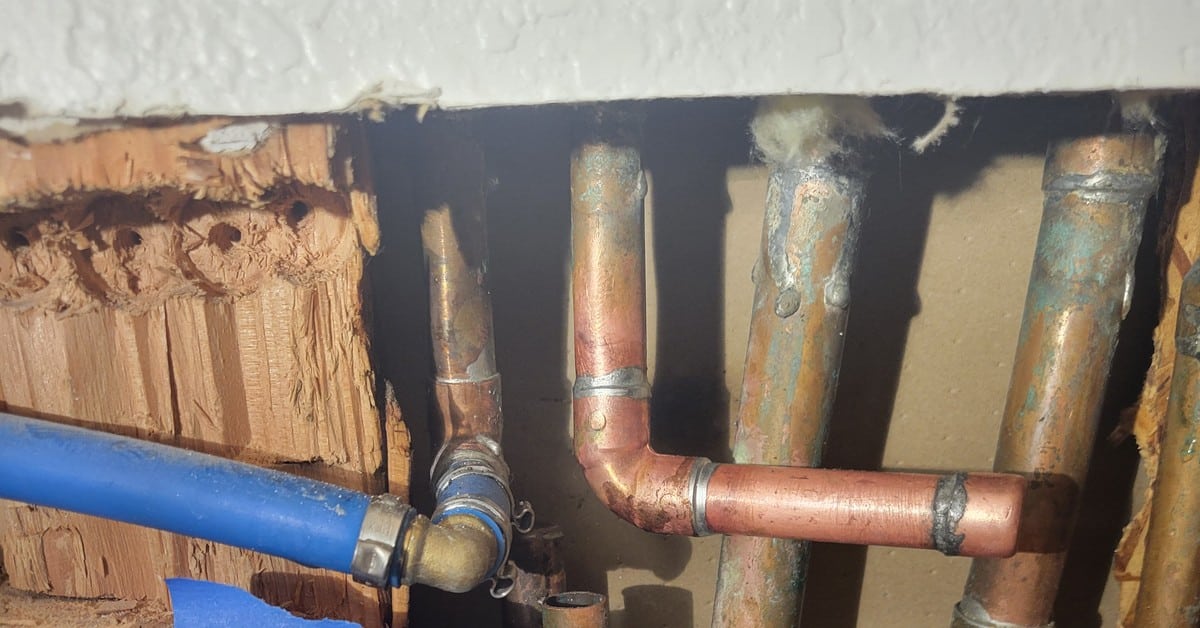
- A slab leak is a hole in a copper water line that runs through the concrete foundation of the home.
- The hot water line leaks far more often than the cold because copper expands and contracts with temperature.
- Warning signs include a new warm spot on the floor, a rising water or gas bill, and the meter spinning with nothing running.
- Three repair options exist: spot repair, reroute through the attic or walls, or full repipe. After three slab leaks on the same system, repipe is usually the right answer.
- A free on-site estimate is given before any repair, with the price in writing before we begin.
You step out of the shower onto a tile floor that is noticeably warmer than the tile around it. The warm patch was not there yesterday. The water bill came in higher than usual, and last night you heard water moving through the wall when nothing was running. Something is wrong, and it might be under the slab.
A slab leak is a hole in a copper water line that runs through the concrete foundation of the home. Most Orange County homes sit on a slab. The original copper water lines run beneath that slab. A slab leak can develop on either the hot or the cold line. Most leak on the hot side. Finding the leak early keeps the repair straightforward. The cost and disruption climb when nobody finds it.
What a slab leak is
Slab leak. A hole in a copper water line that runs through the concrete foundation of a home.
The line could be the cold water main feeding fixtures throughout the house, or the hot water line that loops back from the water heater to each fixture. Both run inside or beneath the concrete in most Orange County homes built before recent renovations.
A leak in a copper line in a wall is not a slab leak. A leak in the sewer line beneath the slab is not a slab leak either, even though it also sits under the foundation. The term refers specifically to a hole in the pressurized water supply line where it passes through or under the concrete.
A quick terminology note. The pipes that run under the slab are copper lines. The short braided hoses that run from the angle stop at the wall up to a faucet or toilet are supply lines. Different parts of the system, different jobs. This article is about the copper lines under the slab.
Why this matters in Orange County
Most Orange County homes sit on a concrete slab foundation. Since the 1950s, copper water lines have been the residential standard here. As a result, a meaningful share of the housing stock now runs on copper that is fifty years old or more. The water flowing through that copper has a particular chemistry. According to the Municipal Water District of Orange County (MWDOC), hardness across the service area runs 8 to 19 grains per gallon depending on city, with most of the county in the moderately to very hard range (MWDOC water quality). In addition, the Metropolitan Water District (MWD) treats imported water with chloramines at its Diemer Filtration Plant in Yorba Linda before the water reaches local utilities (MWD water quality).
That chemistry interacts with copper in two ways. On the inside, the dissolved minerals act like a slow, continuous abrasive at the corners of fittings and along the inside wall of the pipe. On the outside, where the pipe passes through or under the slab, the surrounding soil contributes its own chemistry to a slower form of corrosion. Some Orange County areas, including parts of Fountain Valley, Garden Grove, and central county neighborhoods, sit on soil that was farmland not long ago. The dairy farms that operated there in the mid-twentieth century altered the soil pH in ways that still affect buried copper today.
Add the heat-driven expansion and contraction of the hot water line. The original installer poured concrete directly around the pipe. Over time, the pipe moves against the concrete and the result shows up as slab leaks throughout the county. This article is for the homeowners reading it in those homes.
Why the hot side leaks first
The hot copper line expands and contracts with every cycle of the water heater. The cold line barely moves. Over the years, that motion against the surrounding concrete produces stress cracks along the line. Combined with the heat-accelerated chemistry inside the pipe and the soil chemistry outside, the hot line fails first in the large majority of slab leak jobs we run.
This is the reason the earliest warning sign of a slab leak in Orange County is usually a warm spot on the floor.
Common causes of slab leaks
A small number of mechanisms account for almost every slab leak we see.
1. Pre-1965 unsleeved copper through the slab
In Orange County homes built before about 1965, plumbers ran copper lines through and under the slab without any sleeve or wrap. The pipe sat in direct contact with the concrete. As the hot line expanded and contracted, stress cracks formed at the edges where the pipe met the slab. Many older neighborhoods in Huntington Beach and Garden Grove sit on this construction era. Those cracks are now showing up as slab leaks.
2. Installation damage
During the original install, copper lines sometimes got walked on, kinked against a rock, or bent into place by foot. Any dent in the pipe wall creates a place where water flowing through faster than the rest of the pipe causes turbulence. The turbulence accelerates wear at the dent. Most pinhole leaks that show up within the first five or six years of a home’s life trace back to installation damage rather than to wear or chemistry.
3. Wear from recirculation systems
A hot water recirculation pump keeps hot water available at every fixture without waiting. The trade-off is that the same water, with its dissolved minerals acting like fine sandpaper, flows through the pipe 24 hours a day instead of only when the household draws hot water. Over time, that abrasion thins the inside wall of the copper at corners and elbows, where flow turbulence is highest. Newer recirculation pumps come with timers that shut the pump off during the middle of the day and the middle of the night, when no one is drawing hot water anyway. We install them this way to extend pipe life.
4. Aging pipe
Copper lines wear out. After fifty or more years of Orange County water flowing through a pipe, the cumulative wear inside and the cumulative chemistry outside both reach the same end point. Finally, new leaks start appearing without any specific trigger. The pipe is at the end of its service life.
5. Electrolysis at dissimilar-metal connections
Electrolysis happens when copper meets a less noble metal, such as galvanized steel, iron, cast iron, or aluminum, and water passes between them. The less noble metal corrodes and sacrifices itself to protect the copper. Where copper meets galvanized steel in older homes, the galvanized side fails first. The copper survives the exchange, but the joint leaks. This is less common as a cause of pure slab leaks than installation damage or wear, but it shows up in older homes.
6. Soil chemistry from former agricultural use
Parts of Fountain Valley, Garden Grove, and other central Orange County cities sit on land that was dairy farms in the mid-twentieth century. The manure-altered soil pH attacks copper from the outside slowly, over decades. Homes built on that ground in the 1960s and 1970s now reach the point where soil-side corrosion combines with interior wear to produce slab leaks.
Warning signs
In rough order of how often homeowners call us about each one:
- A new warm spot on the floor. The hot copper line is leaking, and the heat from the escaping water warms the concrete directly above the leak. However, be careful with this one: if the home has a recirculation pump and the copper was not installed deep enough in the concrete, the whole floor along the run can warm up. Therefore, the slab leak signal is a warm spot that was not there before, not a generally warm floor.
- A rising water bill. The leak is sending water out under the slab around the clock.
- A rising gas bill. The water heater is working harder to keep up with the constant loss of hot water from the supply line.
- The sound of running water with everything off. Best heard late at night when traffic noise drops. If you can hear water moving through the house but cannot find a fixture running, the supply line itself may be losing water.
- The water meter spinning with nothing running inside the house. The small triangle on a residential water meter rotates whenever water is flowing through the service. If everything in the house is off and the triangle is still moving, water is going somewhere between the meter and the fixtures. Two false positives need to be ruled out first: a leaking irrigation system and a toilet leaking by at the flapper. Both are covered next.
- Mildew smell or wet drywall at a baseboard. Water from a slab leak eventually migrates upward. By the time it is visible, the leak has usually been running for weeks or months.
Stop reading and act if water from the leak has reached anything electrical.
If water from a slab leak has reached an outlet, the breaker panel, or any plugged-in appliance, the immediate hazard is shock, not plumbing. Take these actions in order.
- Leave the affected area. Call 911 if there is any sign of arcing, smoke, or shock risk to anyone in the home.
- Cut power to the affected circuit at the breaker panel only if you can reach it without crossing standing water.
- Shut the home's main water off at the curb or in the yard to stop the leak.
- If the floor over the leak is hot enough to burn, keep children, pets, and anyone with reduced sensation away from that part of the floor.
- Call us at (714) 964-3519 once the immediate hazard is contained. We are available 24 hours a day, every day of the year.
What homeowners often mistake for a slab leak
Two false positives come up so often they are worth ruling out before any locating equipment comes off the truck.
Toilets leaking by. A toilet with a worn flapper drains water slowly from the tank into the bowl. The fill valve then tops the tank back up. Quietly, the toilet refills. The meter spins. To the homeowner, the pattern looks like a slab leak signal. A toilet leaking by can lose several gallons of water a day.
The test is simple. Put a few drops of food coloring in the toilet tank, not in the bowl. Do not flush. Wait 20 or 30 minutes. If the color shows up in the bowl, the flapper is leaking. That is a small repair, not a slab leak.
Irrigation systems. A buried irrigation line with a leak somewhere in the yard will keep the meter spinning around the clock. Most homes have an irrigation isolation valve. Closing it shuts off the entire irrigation supply separately from the house. When the meter stops spinning, the leak is in the irrigation, not under the slab.
Suppose the meter is still spinning with the irrigation off and every fixture closed. In that case, isolate the house at the main shutoff valve. If the meter then stops, the leak sits somewhere inside the home. A slab leak becomes the leading suspect.
What a homeowner can safely check before calling
These five steps are safe to do before the phone call. None of them require touching the pipes.
- Read the water meter. Note the position of the small triangle and the dial.
- Run the food coloring test on every toilet in the home.
- Shut off the irrigation isolation valve if the home has one. Check the meter again.
- Isolate the house at the main shutoff valve. Check the meter again.
- Walk the floors barefoot in the morning. Note any warm spots that were not there last week.
These five steps give us a much sharper starting picture when we arrive. Anything beyond this is outside what a homeowner should attempt. Misdiagnosis risk is high. Locating equipment is specific. Cutting into the slab and soldering new copper is licensed work. For all of that, you need a plumber.
How we locate a slab leak
The diagnostic process follows the same order we use to confirm the leak in the first place, then narrows from there.
Confirming the leak
- Confirm the meter is moving. The triangle on the water meter tells us water is flowing somewhere.
- Isolate the irrigation, then the house. This confirms the leak is inside the home.
- Shut the toilets off at the angle stops. Toilets are notorious for false positives on slab leaks because they can lose a lot of water in a day.
- Shut off the cold water inlet at the water heater. If the meter stops at this point, the leak is on the hot side. If the meter keeps spinning, the leak is on the cold side.
Pinpointing the location
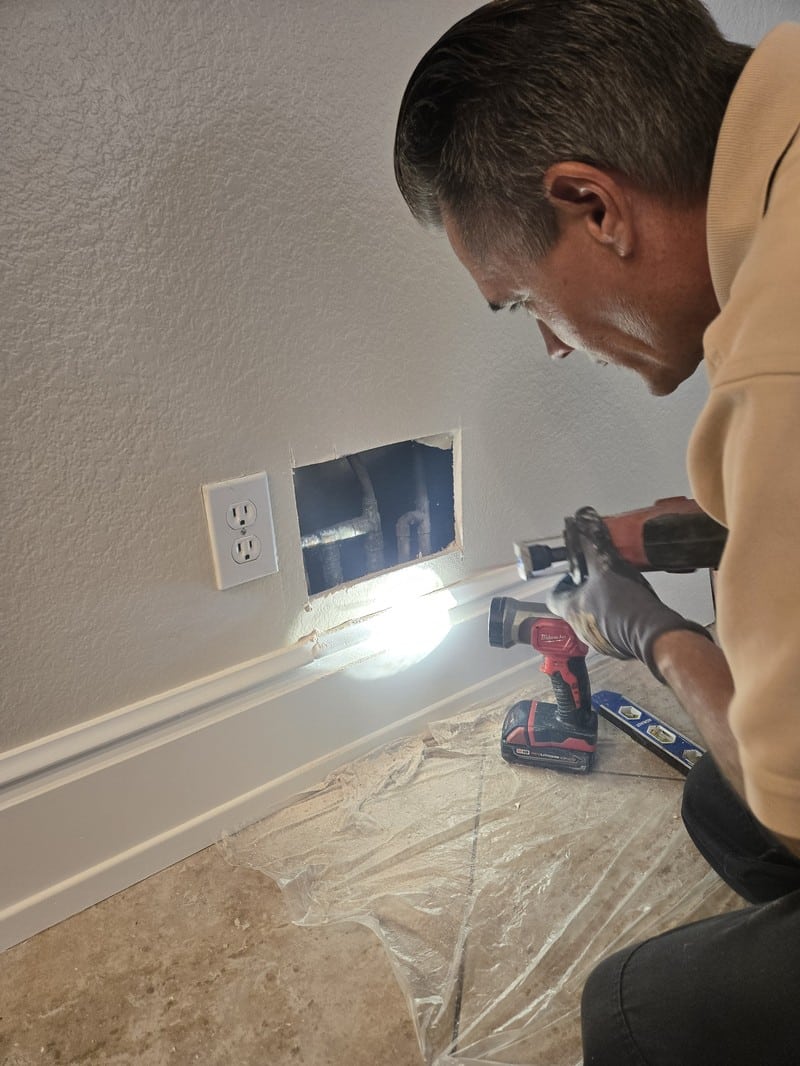
Once we have confirmed the leak and identified the side, the locating equipment comes off the truck.
Our primary tool is an acoustic listening device, amplified and filtered so a trained operator can hear water escaping from the pressurized line through the concrete. Goldak, Leaktronics, and Metrotech are the brands we use. The acoustic locator narrows the leak position to within an inch or two of the actual hole.
When the acoustic signal is faint, which happens with small leaks, deep pipe, or background noise in the home, we inject CO2 air pressure into the copper line. The escaping CO2 changes the sound signature at the leak and makes it easier to pinpoint.
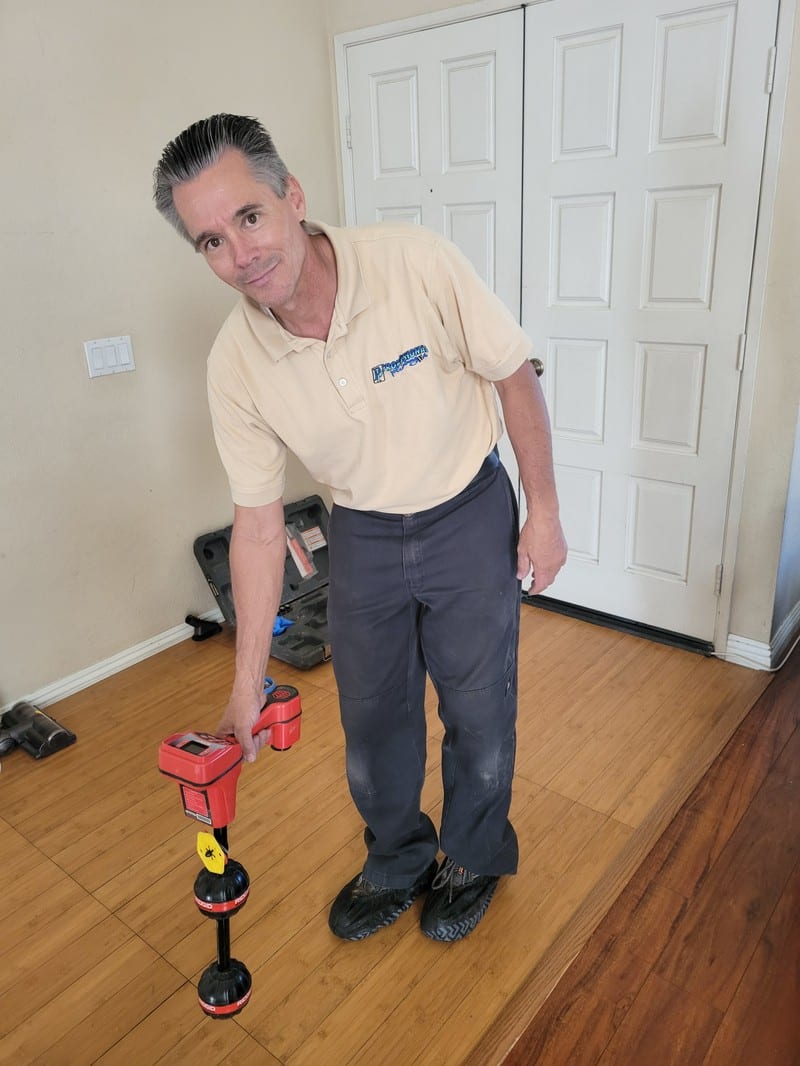
We also use line locators to map the path of the copper through the slab before opening the floor. The locator energizes the line and tracks its position from above. The result is an accurate map of where the copper runs, which reduces the chance of opening the slab in the wrong place.
Why we do not lean on thermal imaging
Thermal imaging can find warm spots. However, it also finds other warm spots that are not slab leaks, which leads to false starts. Our acoustic listening equipment combined with CO2 injection and line tracing is the most accurate combination available.
If the locating does not give a clean answer the first time, we change the listening position, increase the CO2 pressure, or re-map the line until the leak signature is consistent. We do not open a floor without confidence in the location.
Repair options: spot repair, reroute, or repipe
Three repair paths exist for any slab leak. Which one is right depends on the home, the location of the leak, the age of the pipe, and what the rest of the system looks like.
When we recommend a reroute
Most of the time we suggest a reroute. Once a pipe has started failing, leaks tend to keep appearing along the same length of pipe, and rerouting moves the whole section out of the slab for good. A spot repair makes sense on newer homes where the leak is likely an installation problem rather than a wear problem, or on older systems where a full reroute is impractical because of the path involved.
We push back on spot repairs when the math no longer works. Some leaks sit under a water heater that has to be drained and pulled. Others sit under a tiled shower floor. Still others sit under granite countertop and the cabinet beneath it. In those cases, the spot repair cost approaches or exceeds the reroute cost. The reroute also moves the rest of the original pipe out of the slab. We quote both options and explain which one we would choose in our own home.
When we recommend a full repipe
The full repipe trigger we use is three slab leaks. By the third leak on the same system, the pipe is wearing out and the next leak is coming. Continuing to pay for spot repairs costs more over a few years than the repipe would.
Rerouting during a remodel
The other time we suggest a partial reroute is during a remodel. When a homeowner is redoing a bathroom, the walls are already open. That is the right time to put in a new shower valve and reroute the line overhead. The result is pipe out of the slab while the work is convenient.
Post-tension slabs
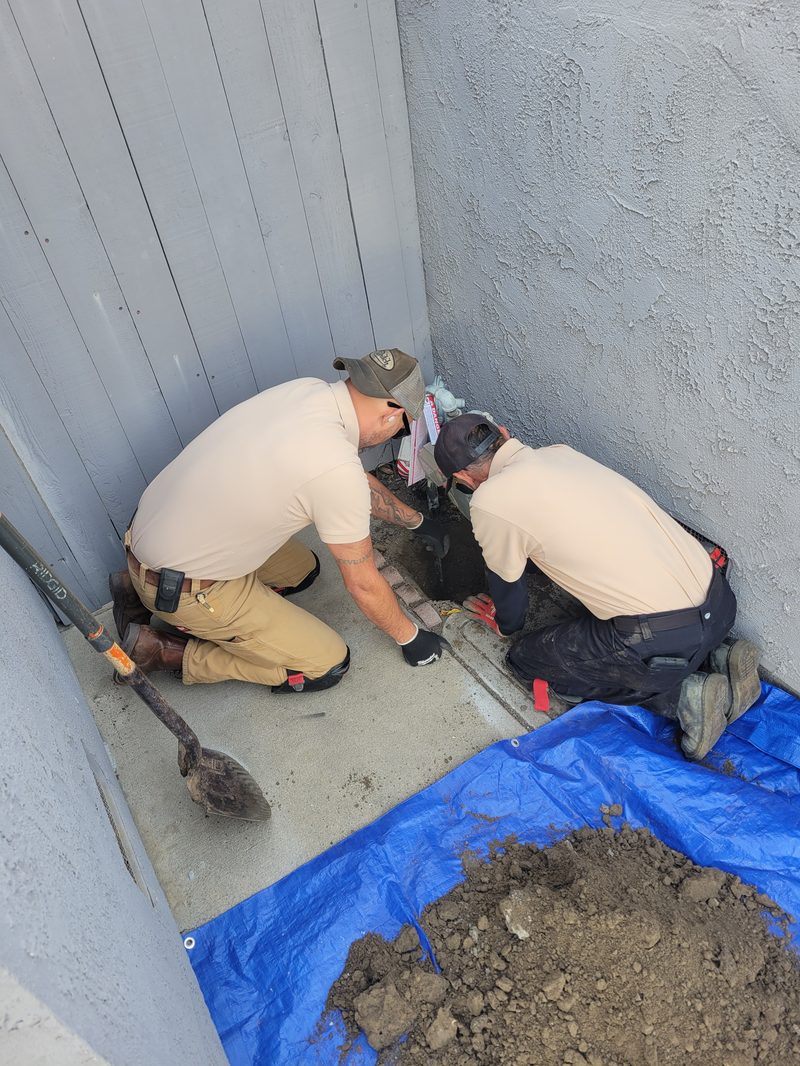
Some Orange County tract homes built from the early 1980s onward sit on post-tension slabs. Steel tendons run through the concrete and are stressed to thousands of pounds of tension. Cutting through a tendon during a slab opening can cause both structural damage and serious injury. We scan a post-tension slab with ground-penetrating radar before any cutting on these homes.
On a post-tension slab, we usually recommend a reroute over a spot repair to avoid the cable risk entirely. The exception is when the reroute would be impractical, for example a vaulted-ceiling home where the new line would have to travel three rooms to reach a usable path. In those cases a spot repair with full cable mapping is the better answer.
Trenchless and epoxy options
Two categories of work get pushed online for slab leaks. Both deserve a clear answer.
Trenchless reroute under a slab is not practical. Trenchless techniques work for a water service line running from the curb to the house, where the existing path is straight and accessible from both ends. They do not work for the branching, fixture-to-fixture path that supply lines take under a residential slab. By the time the work is priced, digging up the line and replacing it with new copper is usually cheaper anyway. For more on legitimate trenchless work, see our page on trenchless slab leak repair.
Epoxy lining works, until it does not. Coating the inside of a copper line with epoxy can buy time. However, one small crack in the epoxy lets water back under the coating. Water then attacks the same pipe wall the lining was supposed to protect.
The bigger issue is what happens later. When the homeowner wants to move a wall, add a bathroom, or remodel the kitchen, the system has to be modified. Epoxy-lined copper cannot be soldered. The only way to connect to it is with push-on fittings such as SharkBite, which is not how professional plumbing is built. If a repair is going to happen, the right move is to reroute the water line in new copper.
A note on PEX
PEX is plastic tubing that has been used in residential plumbing as an alternative to copper for several decades. We have our eye on the PEX market right now because we have been hearing about a failure mode in some PEX products where the pipe wall develops spider-web fractures along its length. The pipe looks like shattered glass without being broken, and the fractures eventually leak. We have not seen the issue reported on every type or color of PEX, but enough of the field reports concern us that we are skeptical of recommending it for a major reroute or repipe right now.
For a slab leak reroute or repipe in Orange County, our default material is copper Type L. The decision can be revisited on a job-by-job basis when the homeowner has a specific reason to prefer one or the other.
Can you prevent a slab leak?
Not entirely. Copper that has spent fifty years in Orange County soil and water reaches the end of its life eventually, no matter how careful the homeowner is. What you can do is slow the wear, take pressure off the system, and catch a leak early enough that it stays a small repair instead of a flooded floor.
A few things make a real difference:
- Keep your water pressure in check. High water pressure stresses every joint and fitting in the home, including the copper under the slab. Anything above 80 psi is hard on the system, and California code requires a pressure regulator at the main once street pressure climbs past that. We check pressure on most service calls and can tell you where yours stands.
- Put a timer on a recirculation pump. If the home has a hot water recirculation pump running around the clock, the same mineral-laden water wears the inside of the copper 24 hours a day. A timer that shuts the pump off overnight and during the middle of the day, when no one is drawing hot water, extends the life of the line.
- Consider a whole-house leak detector with automatic shutoff. These devices install at the main, learn the home’s normal water use over a week or two, and shut the water off when they sense a leak. They will not stop a slab leak from forming, but they can turn a catastrophic overnight flood into a contained problem you handle in the morning.
- Treat hard water. Orange County water runs hard, and the dissolved minerals act like a slow abrasive on the inside of copper. A water softener or conditioner will not undo years of wear, but on a newer system it slows the interior corrosion that contributes to pinhole leaks.
- Have the system looked at periodically. On a home past forty years old running original copper, an occasional pressure check and a look at the water heater and the visible lines catch the early signs before they become a leak under the slab.
None of this is a guarantee. The homeowners who go the longest between slab leaks are usually the ones running reasonable pressure, treating their water, and paying attention to the early signs.
Cost considerations
Slab leak pricing depends on access more than anything else.
What moves the price
The variables that move the price most, in roughly the order we see them:
- The location of the leak. Under bare concrete or carpet is the easiest case. Tile, hardwood, granite, or a built-in fixture is harder. A water heater that has to be drained and pulled is harder still. The worst case is a tiled shower or tub.
- Whether the home is on a conventional or a post-tension slab. Post-tension slabs require GPR scanning before any concrete cutting.
- The distance a reroute has to travel when a reroute is the right answer. Short overhead reroutes are quick. Long reroutes through multiple ceilings or around vaulted spaces add labor.
- The number of leaks. A single leak is a job. Two or more leaks in the same home over a short period shifts the conversation toward reroute or repipe.
- Code upgrades triggered by the work. Some jurisdictions require additional work, including new shutoff valves and code-compliant connections at fixtures, when a repipe is performed.
- Permit cost. Pass-through at the city’s actual fee. The homeowner may pull the permit themselves if they prefer.
Why we do not publish dollar figures
We do not publish dollar figures for slab leak work in this article. Orange County pricing is not representative of pricing in other regions. Even within the county, the same job varies by access conditions in any specific home. Every estimate includes a written price before any repair work begins. If diagnostic work is needed first to confirm the right scope, we quote the diagnostic work separately and get authorization before we touch anything.
Slab leak quotes can vary significantly between companies. If you have gotten a quote for a job of $2,500 or more and would like a second opinion, we do them for free. The customer needs to have a written estimate from the other company. Call or ask for details.
Homeowners insurance and slab leaks
The insurance industry has changed its coverage of slab leaks over the last several years. Many policies now cover the water damage a slab leak causes but not the pipe repair itself. Some carriers have added slab leak exclusions or sub-limits at renewal. The specifics depend on the carrier and the policy.
What standard policies typically cover
- Water damage to flooring, baseboards, walls, and personal property from a sudden and accidental loss.
- The access work, including the cost of tearing out and replacing the slab or finishes needed to reach the failed pipe, when the underlying loss is covered.
What standard policies typically do not cover
- The pipe repair itself. The cost of replacing the section of pipe is the homeowner’s.
- Damage from long-term gradual leaks the homeowner should have noticed.
- Damage from earthquake. California earthquake coverage is sold separately.
- Damage from faulty installation or normal wear and tear.
The sequence we recommend
For a homeowner who suspects a slab leak: document the situation with photos and a meter reading, shut off the main if water is visibly present, and call us. We do the diagnosis and the written estimate. With the estimate in hand, the homeowner calls the insurance carrier with a clear description of what has happened. Calling insurance before there is a confirmed diagnosis often produces a claim that is denied for vague cause. We prefer to talk to the insurance company directly when the homeowner is comfortable with that, because one wrong word on the phone can throw a claim out.
When the leak is under a finish that would be expensive to remove and replace, we quote both the spot repair (with the demo and rebuild) and the reroute. The reroute is often the cheaper option overall, and the carrier is usually willing to take the cheaper of the two when both are documented.
HOAs and condos
Slab leaks in condos, townhomes, and apartment buildings divide responsibility differently from single-family homes.
- Apartment buildings are owner-responsibility. The building owner pays for the repair.
- HOAs are mixed. If the building has one water service for the whole structure and many units share the supply lines, the HOA is usually responsible. If the condo has its own water service, its own water heater, and its own supply lines, the unit owner is usually responsible.
- Common-wall situations add complication. A pipe that runs along or through a wall shared with a neighbor may fall under either responsibility depending on how the CC&Rs are written.
The best starting point for any condo or HOA homeowner is the CC&Rs (Covenants, Conditions, and Restrictions) for the property. They spell out who is responsible for what. We have worked enough HOA jobs to walk a homeowner through what their CC&Rs probably mean, but the document itself is the ground truth.
Misconceptions
A few things homeowners come in believing that are worth pushing back on.
“They are going to jackhammer my whole floor.” No. Our acoustic locating equipment places the leak within an inch or two of the actual hole. The opening we cut is usually about 18 inches across, enough to work and no more. An exception applies when more than one leak is found in close proximity, which sometimes requires a slightly larger opening.
“I will wait this out until I can afford it.” Do not. The water flowing through the pipe carries microscopic mineral particles that act like a slow continuous abrasive on the inside of the pipe wall. A pinhole growing under pressure gets larger fast. Waiting turns a contained slab leak into water surfacing through the floor, finish damage to the home, and a much larger repair.
“Epoxy lining will save my pipes.” It works until it does not, and it locks the homeowner out of any future copper modification. If the system has reached the point where the lining is being recommended, the right next move is a reroute or a repipe.
“Insurance will cover the whole thing.” Increasingly not. Most policies cover the damage and the access work. The pipe repair itself is the homeowner’s cost, and some carriers have added slab leak exclusions at renewal. Check the policy before assuming.
“Slab leaks are devastating.” They are not good news. But they are routine repair work. A spot repair takes a day. A reroute takes one to two days. Drying and patching the damage takes another day or two. Life gets back to normal. Most of the fear comes from horror stories that do not match what the work involves.
Real Orange County slab leak jobs
A reroute behind a water heater on a local naval base
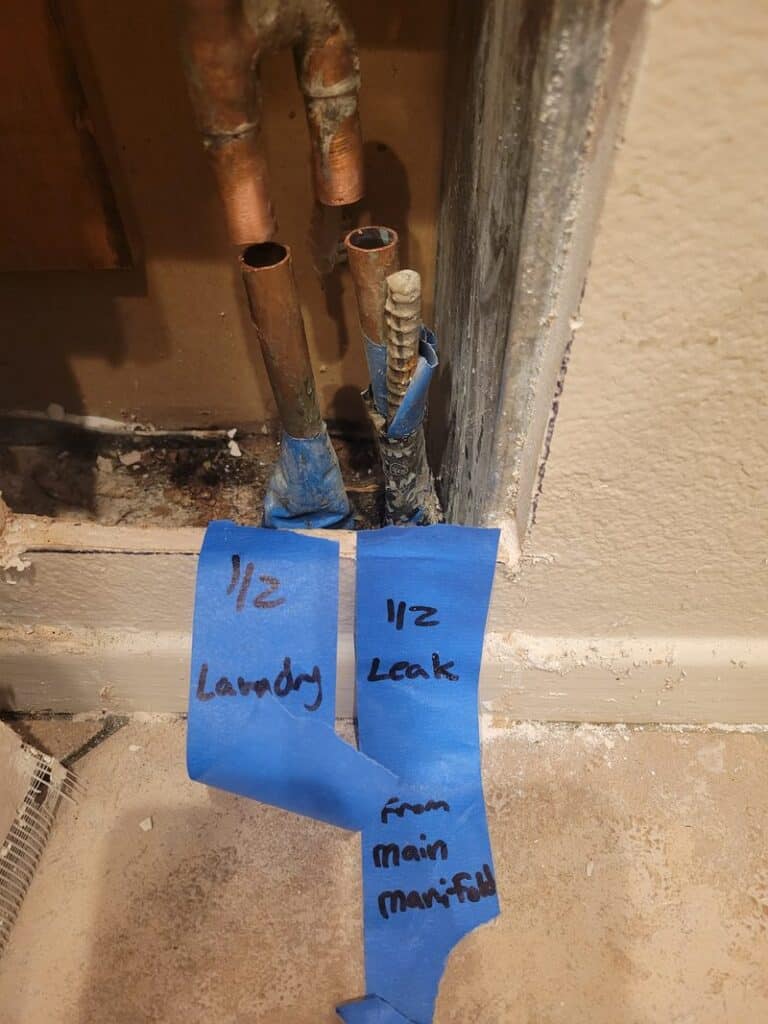
We located a slab leak behind a large water heater at one of the local naval bases. The leak itself sat on a short section of copper, maybe five or six feet of pipe looping under the slab from the water heater to a nearby fixture. Overall, the pipe length we used to reroute around the leak came in at about 20 feet, running overhead and back down through the wall.
The reroute was the obvious call. A spot repair would have required draining and pulling the water heater first. The labor for that pull would have approached the reroute cost. None of it would have solved the problem long-term. The original install ran the pipe under the slab because that was the cheap, fast way to do it during construction. The reroute moved the line out of the slab for good.
A spot repair under a living room carpet in Fountain Valley
A homeowner in Fountain Valley called about a slab leak in the middle of the living room floor. We located the leak and started planning the work. The complication was the path. The water service came into the house directly beneath a large picture window. That left no clean route for a reroute. Any reroute would have meant either an exposed line on the outside of the building or a visible chase on the inside.
We peeled back the carpet, cut an 18-inch opening in the concrete over the located leak, replaced the failed section of copper, and patched the floor. Carpet went back over the patch. The spot repair was the right answer because the reroute was not practical. Since then, the homeowner has not had another leak.
A repipe in Garden Grove after the fourth slab leak
A customer in Garden Grove called about a slab leak in a bedroom that ran through the slab to a bathroom on the other side of the home. We located the leak and opened the floor. Right next to where we were working sat a previous concrete patch from an earlier repair. Talking with the homeowners, we learned this was their fourth slab leak in a little over two years. No recirculation pump on the system. Just worn-out copper that had reached the end of its service life on Orange County water.
Other plumbers had handled the earlier repairs as spot repairs. None of them had told the homeowner that the pattern of leaks meant the system was at the end of its life. None had told them that a repipe was the right move. We quoted the repipe alongside the spot repair on this leak. The homeowner chose the repipe. They have not called us about another slab leak.
What does a slab leak feel like, day to day?
Most slab leaks start with one of the warning signs above. A new warm spot on the floor. A rising water or gas bill. The sound of water at night. A meter spinning with everything off. Some leaks produce no symptoms a homeowner can notice for weeks or months. The diagnosis is the same either way. Confirm the leak with the meter. Isolate the source. Locate it with acoustic equipment.
Can a slab leak fix itself?
No. Mineral deposits inside the pipe can occasionally narrow a leak for a short time. The underlying mechanism, the hole in the pipe wall, keeps progressing. A pinhole leak that stops on its own is a leak that has slowed. It will return.
How long does the repair take?
A spot repair usually finishes in a single day. A reroute takes one to two days depending on the distance and the access. For a typical Orange County home, a full repipe runs three to five days. Damage repair to drywall and flooring follows the plumbing work and adds time depending on the finishes involved.
Do I have to leave the house during the repair?
No, in most cases. Water stays off during the repair itself, which usually takes a few hours. Reroutes and repipes involve longer shutoffs. We stage the work so the home is back on water by the end of each work day.
Should I shut the water off as soon as I suspect a slab leak?
If the leak is producing visible water or damage, yes. If the leak is only suspected from a warm spot or a slow meter, leave the water on until we arrive. The leak signal is what we use to locate the hole. Shutting the water off too early can stop the acoustic signature we need.
What is a post-tension slab and how does that change the work?
A post-tension slab has steel tendons running through the concrete. The tendons are stressed to thousands of pounds of tension. Cutting through a tendon during a slab opening can cause structural damage and serious injury. Post-tension slabs are common in Orange County tract homes built from the early 1980s onward. We scan the slab with ground-penetrating radar before any cutting on a post-tension home. We usually recommend a reroute over a spot repair on a post-tension slab to avoid the cable risk entirely.
Will I need a permit?
Most slab leak repair work is permit-required in California. We pull the permit as part of the job and pass the city fee through at cost. Homeowners can pull their own permits if they prefer. The process is online in most Orange County cities.
My quote says trenchless slab leak repair. Should I take it?
Read the quote carefully. Trenchless techniques work for the water service line that runs from the curb to the house. They do not work as a reroute under a slab. If the work being quoted is an epoxy lining of the existing pipe, the considerations in the epoxy section above apply. If the work being quoted is a true reroute through the walls and attic, that is the same reroute described in the repair options section. The language in the quote should describe accessible above-slab pipe runs.
What to do if you suspect a slab leak
- Check the water meter with everything off inside the house. Note whether the small triangle is moving.
- Run the food coloring test on every toilet to rule out a flapper leak.
- Shut off the irrigation isolation valve if the home has one, then check the meter again.
- Isolate the house at the main shutoff valve and check the meter one more time.
- Walk the floors barefoot in the morning. Note any warm spots that were not there last week.
- Call us. The acoustic locating, CO2 injection, and line tracing are the tools that confirm the leak and pinpoint the location.
If you would like us to come out
Availability and the estimate
If you would like us to come out and take a look, we are available 24 hours a day, every day of the year. Estimates are free during normal business hours, Monday through Saturday, for work we can see and price on site. If finding the leak requires diagnostic tools or testing, we quote the diagnostic work before we begin. We then quote the repair in writing before any repair work starts. After hours and on Sundays, the visit is at overtime rates. We give a two-hour window and call when the truck is on the way.
What we will tell you when we get there
If the warm spot turns out to be a recirculation pump warming the floor along the entire pipe run, we will tell you that. If the meter signal turns out to be a toilet flapper, we will tell you that too. If it is a slab leak, we will walk you through the spot repair, reroute, and repipe options and the cost on each one.
We repair slab leaks across Orange County, including Newport Beach and Costa Mesa.
Disclaimer
Plumbing codes vary by jurisdiction and are updated periodically. The code references in this article reflect current California Plumbing Code requirements as of May 27, 2026. Local building departments may apply additional requirements or amendments. Confirm current code requirements for your specific city or county with the local building department before relying on this article for permitted work.
Disclaimer
This article describes how some plumbing situations are typically treated by homeowner's insurance policies in California. Actual coverage depends on the specific policy and the specific situation. Professional Plumbing is not a licensed insurance professional. For coverage questions about your specific policy, contact your insurance carrier directly.

About the author
William Horsky owns Professional Plumbing, Inc. He founded the company in Orange County in 1985 and has served the area continuously since then. The company has been licensed by the California Contractors State License Board since 1987 (CSLB license number 517514, classification C-36, current and active) and incorporated as Professional Plumbing, Inc. in 2001. The company operates from offices in Fountain Valley, Garden Grove, Huntington Beach, Costa Mesa, and Newport Beach, and serves homeowners and businesses across Orange County.
Have a question?
If you are trying to understand a plumbing problem at your home, weighing your options, or working through a DIY project, you are welcome to call. The number is (714) 964-3519.
During business hours you will reach me or one of my guys. After hours, our AI assistant can answer common questions or take down your information, and I will follow up the next business day. In the event of an emergency, our AI assistant can connect you directly to a plumber at your request.
There is no obligation to schedule service. We like talking to people in our community, and sometimes a phone call answers what an article cannot.
William Horsky
Owner, Professional Plumbing, Inc.
Serving Orange County since 1985.