

Newport Beach Water Heater Service: High Pressure, Tankless, and Recirculation
By William “Jay” Horsky Jr., Owner, Professional Plumbing, Inc. · Published June 25, 2026 · Updated June 25, 2026
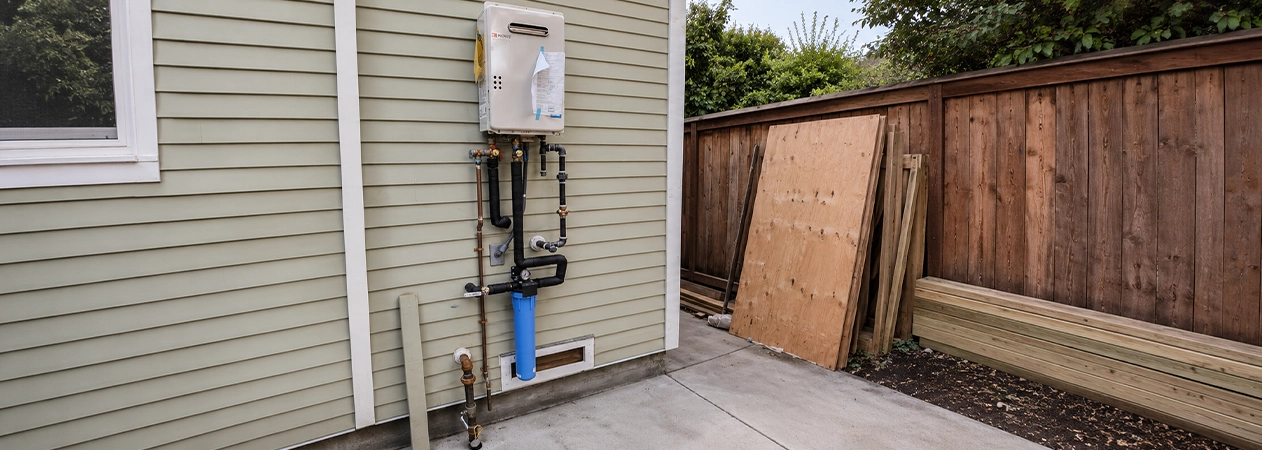
Exterior-mount tankless water heater service on a Newport Beach home
Newport Beach water heater service covers repair, replacement, and maintenance for tank, tankless, electric, gas, and hybrid units. Here a tank often fails less from age than from pressure. The imported supply runs hard, in the mid-teens grains per gallon, so sediment still builds, but many hillside homes also sit on high municipal water pressure, and high pressure shortens a water heater’s life and stresses the whole system. Reading the pressure is often the first thing we do.
Check the pressure before the heater
- The first thing we put a gauge on is line pressure, because on Newport’s hillsides a tank tends to give out from the high pressure feeding the home rather than from age alone.
- A weeping relief valve usually points to that pressure or a missing expansion tank, not a faulty valve, so a pressure-reducing valve paired with a right-sized expansion tank guards both the heater and the rest of the plumbing.
- The imported supply still runs hard in the mid-teen grains, leaving deposits that settle in a tank and force a periodic descale on any tankless exchanger.
- Newport Beach water heater service often means tankless and exterior-mount units, with recirculation on the larger estates, and a conversion that may need the gas line run or upsized.
What Newport Beach water heater service covers
Repair, replacement, tankless and exterior-mount installs, recirculation for the larger homes, and the maintenance that buys years. On a tank we flush sediment, check the anode, and test the relief valve. On a tankless we descale the heat exchanger. And we check and correct water pressure, because in Newport that is often the hidden cause behind a heater that failed early. We work on every type and fuel.
Why high pressure shortens a Newport Beach water heater
The imported water Newport receives runs hard, mid-teens grains per gallon, so the familiar sediment story applies (City of Newport Beach). But the bigger killer on the hillsides is pressure. Where the municipal supply comes in high, the tank, the relief valve, and the connections all take more strain, and the heater wears out before its time. A pressure-reducing valve and a properly sized expansion tank protect the heater and the rest of the plumbing.
Pressure, the relief valve, and what we check first
On a Newport home that has gone through heaters quickly, pressure is the usual suspect, and the fix protects far more than the tank.
| What we find | What it does to the heater | The fix |
|---|---|---|
| High incoming water pressure | Stresses the tank, valve, and fittings; early failure | Install or set a pressure-reducing valve |
| No or failed expansion tank | Pressure spikes each heating cycle on a closed system | Fit a correctly sized expansion tank |
| A weeping relief valve | Often a symptom of pressure or expansion, not a bad valve | Solve the pressure, then replace the valve |
| Hard-water sediment | Bakes onto the tank floor and traps heat | Flush annually; descale a tankless |
Tankless, exterior mounts, and recirculation in Newport
Newport’s homes lean toward tankless and exterior-mounted units, and the larger ones want recirculation so hot water reaches a distant primary bath quickly. We size and place them to suit the home, run or upsize the gas line a tankless conversion often needs, protect any exterior run, and set the pressure and expansion correctly so the new unit lasts. On a replacement or a recirculation project you want a second read on, our free second opinion is there. Call or ask for details.
By the numbers. Since 1985, Professional Plumbing has completed more than 36,900 plumbing jobs across Orange County, and Newport Beach has been on that route from the start.
Newport Beach water heater FAQ
Why does my Newport Beach water heater keep failing early?
Your Newport Beach water heater often fails early because of water pressure, not age. Many hillside homes receive high municipal pressure that strains the tank, the relief valve, and the connections. A pressure-reducing valve and a correctly sized expansion tank protect the heater and the whole system.
Does Newport Beach have hard water too?
Newport Beach does have hard water too. The imported supply runs in the mid-teens grains per gallon, so sediment still builds on the tank floor. An annual flush helps, but pressure is the bigger variable on the hillsides.
Why is my relief valve dripping?
A weeping temperature-and-pressure relief valve is usually a symptom of high pressure or a missing expansion tank, not a failed valve. We solve the pressure first, then replace the valve.
Can you install a tankless or exterior-mount unit?
We install tankless and exterior-mount units, and both are common in Newport. We size and place the unit to the home, protect any exterior run from the elements, and set the pressure and expansion so it lasts.
Do I need a pressure-reducing valve?
You need a pressure-reducing valve if your incoming pressure is high, which it often is on the Newport hillsides. It protects the water heater and every other fixture and appliance in the house.
Disclaimer
Water heater work is permitted and code-governed, including seismic strapping and thermal-expansion requirements. Plumbing codes vary by jurisdiction and are updated periodically. Code references here reflect current California Plumbing Code requirements as of the date above. Confirm current requirements with the City of Newport Beach before relying on this article for permitted work.
What happens when you call us
Tell us the history: no hot water, a leak, a dripping relief valve, a heater that failed sooner than it should, or a tankless or exterior-mount install you are planning. We check the water pressure first, diagnose the unit, and give a straight repair-or-replace answer. A leak is an emergency. We are available 24 hours a day, every day, with a two-hour window and a call when we are rolling.
Have a question?
Glad to help. If your Newport Beach water heater is acting up, or you are weighing a repair against a replacement, you are welcome to call. The number is (949) 822-9548.
During business hours you will reach me or one of my guys, and there is no obligation to book anything. A quick call often answers what an article cannot.
William “Jay” Horsky Jr.
Owner, Professional Plumbing, Inc.
Contact our Newport Beach office
Professional Plumbing, Inc.
120 Newport Center Dr #60, Newport Beach, CA 92660
Phone: (949) 822-9548
Available 24 hours a day, every day of the year.
No hot water or a leaking tank? See our 24/7 emergency plumbing services.
About the Author
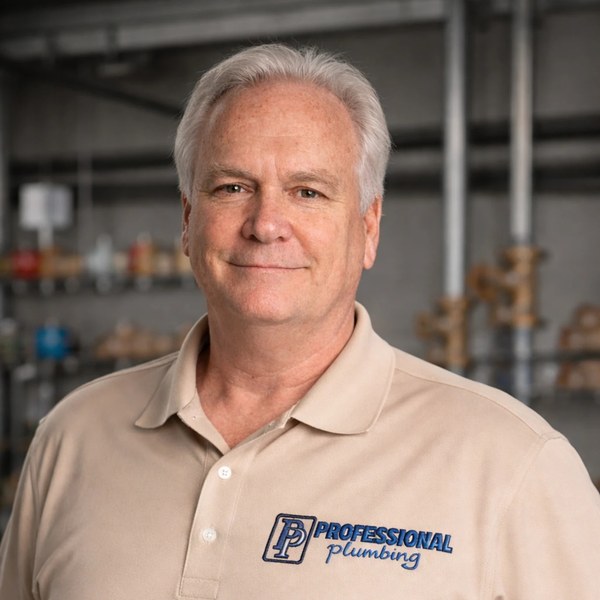
William "Jay" Horsky Jr., who has more than 40 years in the trade, owns Professional Plumbing, Inc. He founded the company in 1985 and has served Newport Beach continuously since then. The company has been licensed by the California Contractors State License Board since 1987 (CSLB license number 517514, classification C-36, current and active) and incorporated as Professional Plumbing, Inc. in 2001. The company is a 2026 BBB Torch Awards for Ethics finalist. Regional manager Nick Haas oversees the company's field crews across Orange County.
Serving Newport Beach since 1985.
More plumbing help in Newport Beach
Beyond the heater itself, the Newport Beach plumber hub and our countywide water heater page connect to the rest of what we do nearby: drainage & sewer, slab leak detection, fixture installation, and commercial plumbing.
What Newport Beach customers say
Real reviews from our Newport Beach Google Business Profile.
★★★★★
“I had a rotted pipe in the drain line in my garage. Professional Plumbing was the second company I called. I was not comfortable with the first company. I have an old house and had concerns with the age of my pipes. Nick listened to my concerns and was able to fix the problem. The work was done in a professional manner and the cost was reasonable. I will definitely call Professional Plumbing first next time!”
— Dennis Chaplin, verified Google review, 2026/06/23
★★★★★
“Nick Haas is an amazing plumber. He has worked on my houses for about 26 years, and I have always been impressed by his professionalism, expertise, and reliability. No matter the size of the job, Nick consistently delivers high-quality work and takes the time to do things right. Over the years, he has handled everything from routine repairs to more complex plumbing projects, and I have complete confidence in his recommendations and workmanship. He is honest, dependable, and always responsive when help is needed. It's rare to find someone with Nick's level of skill and integrity. After more than two decades of outstanding service, I can recommend him without hesitation to anyone looking for a knowledgeable and trustworthy plumber.”
— Mad Dan, verified Google review, 2026/06/13
★★★★★
“Jon came over to disconnect a washer and dryer in my house. He was on time, very professional and such a nice person. Jay the owner and his sister Liz were both a delight to work with and I would highly recommend their service to anyone looking for plumbing work. 5 Stars all around!”
— Ben Durrant, verified Google review, 2026/06/16
★★★★★
“Always on time and polite.”
— Susan Kramer, verified Google review, 2026/06/16