
Water Heater Repair Newport Beach
Call 24/7: (949) 822-9548
Professional Plumbing Inc. — 120 Newport Center Dr #60, Newport Beach, CA 92660
Licensed & Insured — CSLB #517514
Water heater repair in Newport Beach usually comes down to a few common failures: a heating element or thermostat on electric units, a gas control valve or ignition issue on gas units, sediment buildup, a leaking drain valve, a T&P relief valve problem, or tank corrosion that finally shows up as a real tank leak. The goal is simple—find the actual failure, show it to you, and fix it without guessing.
In our coastal area, many water heaters don’t make it 8–15 years. A lot of units land closer to 6–10 years depending on water quality, maintenance, and exposure.
Fast Clues (Before You Scroll)
If you have water pooling at the base, we first confirm whether it’s a valve/fitting leak or the tank body. If you have no hot water, it’s usually power, elements/thermostats, ignition, or gas control. If you hear popping or rumbling, sediment buildup is one of the top causes.
Quick Answers
Can a leaking water heater be repaired? If it’s a valve, fitting, or flex line—often yes. If the tank body is leaking—usually no.
Why is my water heater popping? Most often sediment heating and releasing bubbles; a flush can help if the tank is still healthy.
Why does hot water run out fast? Sediment taking up space, a failed heating element (electric), a dip tube problem, or an undersized tank.
Failure Signs (What It Usually Means)
You don’t need a technical lecture. These are the signs we see most, and what they typically point to.
- Rusty or discolored hot water: internal corrosion, anode rod issues, or old piping conditions
- No hot water: tripped breaker, failed element/thermostat (electric), ignition/gas control issues (gas)
- Hot water runs out fast: sediment buildup, failed element, dip tube issues, or undersized tank
- Popping / rumbling / crackling: sediment buildup on the bottom of the tank
- Temperature swings: thermostat/control problems, flow restrictions, or a control/sensor issue depending on heater type
- Pilot won’t stay lit / ignition problems: thermocouple/flame sensing, igniter, gas control valve, airflow/venting basics
- Water at the base: drain valve, fittings, T&P discharge routing, or tank leak
Leak Causes (Most Common Sources)
“Leaking” means different things. We confirm the source first, because the fix changes based on where the water is actually coming from.
- Drain valve leak: A worn drain valve can drip slowly and then worsen. This is one of the most common “puddle at the base” causes.
- T&P relief valve discharge: The temperature and pressure relief valve is a safety device. Drips can be a failing valve, high pressure, or expansion issues. Either way, it’s not something to ignore.
- Flex lines, nipples, and fittings: Corroded or loose water flex lines and connection points can leak and make it look like the tank is failing when it’s not.
- Tank body corrosion: If the tank itself is leaking, repairs usually won’t solve it. That’s typically end-of-life corrosion tied to age, water quality, and anode rod condition over time.

Repairs We Do (By Symptom)
No hot water
- electric: heating element replacement, thermostat replacement, breaker/wiring checks
- gas: ignition diagnosis, pilot/thermocouple checks, gas control valve diagnosis
- both: sediment-related performance issues that mimic “no hot water” or slow recovery
Not enough hot water
- sediment flush when buildup is heavy
- failed element on electric units (upper/lower element issues)
- dip tube problems that shorten hot water delivery
- temperature setting verification for safe, usable performance
Water is too hot or temperature swings
- thermostat/control corrections
- mixing/tempering valve issues when present
- flow restrictions and basic system checks
Strange noises (popping/rumbling)
- sediment buildup is usually the driver
- flushing can reduce noise and improve recovery, unless the tank is already too far gone
Pilot/ignition problems (gas units)
- thermocouple / flame sensing checks
- igniter checks
- gas control valve diagnosis
- venting and airflow basics check for obvious issues
What We Check During a Repair Visit
We keep the visit practical. We’re trying to diagnose the real cause and fix it in a way that lasts.
We typically check:
- water shut-off valve condition and accessibility
- water flex lines and connection points for leaks/corrosion
- T&P relief valve function and discharge routing
- drain valve condition and seepage
- thermostats and heating elements (electric units)
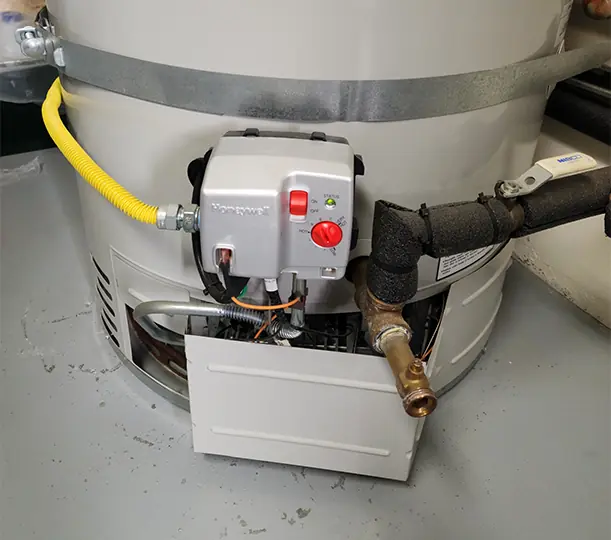
- gas control valve and ignition basics (gas units)
- burner area basics (gas units)
- sediment indicators (noise, recovery time, temperature instability)
- venting basics (gas units) and obvious safety concerns
- visible corrosion that suggests end-of-life
We’ll also show you the leak source or failing part (photo or quick video) so the repair makes sense before we touch anything.
Repair vs Replace (Simple Guidance)
Most water heaters in Newport Beach land in the 6–10 year range, depending on conditions and maintenance.
- Repair usually makes sense when the tank is sound and the failure is parts-based (element, thermostat, valve, ignition).
- Replacement is usually the real fix when the tank body is leaking, corrosion is advanced, or repairs keep stacking up on an older unit.
We won’t push replacement if it’s a clean parts-based repair and the tank is still sound. We’ll give options based on what we actually find—no pressure.
Need a Local Plumber In Huntington Beach?

Professional Plumbing provides free inspections for current homeowners during business hours. A small fee applies for homes in escrow or for sale; this fee can be credited toward repair costs if we’re hired.
Repair Services We Also Offer (Links Later)
This page is the main “Water Heater Repair” page. These are common repair paths we can link out to as you build them:
- Storage Tank Water Heater Repair
- Tankless Water Heater Repair
- Electric Water Heater Repair
- Hybrid Water Heater Repair
- Water Heater Maintenance
- Commercial Water Heater Repair
- Boiler Repair
- Raypak Repair
- Tankless Water Heater Flushing
- Storage Tank Leaking
- Water Tank Repair
Newport Beach Notes
In Newport Beach, a lot of the “slow hot water” problem is simply long distance between the main heater and a far fixture, especially in homes with additions, split levels, or guest areas. We also see more under-sink installs in tighter cabinetry where access gets overlooked. A point-of-use setup can be a great fix—but only when it’s installed cleanly with shutoffs, safe electrical, and enough access to maintain it in the future.
Water Heater Repair FAQs
Sometimes. If the leak is coming from a drain valve, a fitting, a flex line, or the T&P relief valve discharge, repair is often possible. If the tank body itself is leaking, that’s usually end-of-life and replacement is the safe answer.
Most of the time it’s sediment buildup heating up and releasing bubbles. Flushing can reduce noise and improve recovery, but if the tank is older and heavily scaled, the noise can be a sign the unit is aging out.
Common causes are sediment taking up space in the tank, a failed heating element on electric units, a dip tube issue, or a heater that’s undersized for current demand. Diagnosis is usually quick once we see the heater type and symptoms.
A T&P leak is usually water coming from the relief valve outlet or discharge pipe, often related to pressure/temperature or a failing valve. A tank leak is typically water seeping from the body of the heater itself. The fix depends completely on which one it is.
Yes. We repair electric heaters (elements, thermostats, wiring-related issues) and gas heaters (ignition, gas control valve, burner-related basics), plus the common leak points on both types like valves and connections.
If the tank is leaking, corrosion is advanced, or repairs keep stacking up on an older unit, replacement usually makes more sense. If the tank is sound and it’s a clear parts-based failure, repair is often the cleanest path.