

Thermal imaging leak detection: Unmask 1 hidden threat
Why Hidden Leaks Are Every Costa Mesa Homeowner’s Worst Nightmare
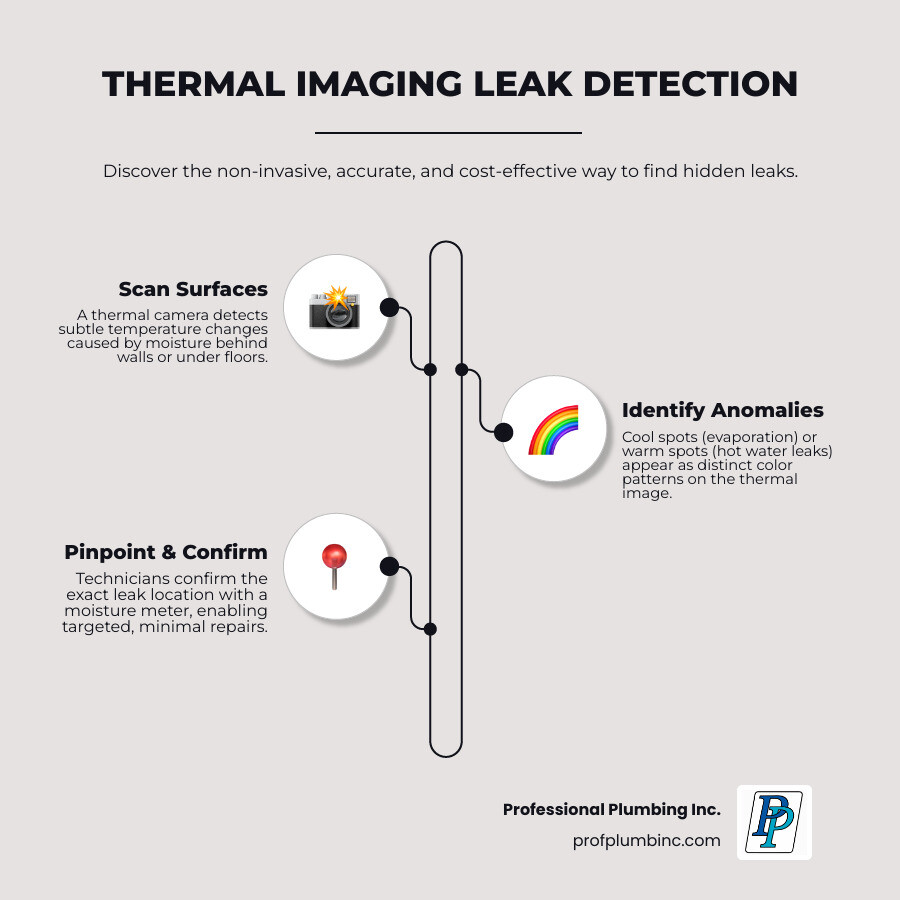
Thermal imaging leak detection is a non-invasive, high-tech method that uses infrared cameras to locate hidden water leaks by detecting temperature differences on surfaces—without cutting into walls, ceilings, or floors.
How It Works in 3 Simple Steps:
- Scan – A thermal camera detects subtle temperature changes caused by moisture
- Identify – Cool spots (from evaporation) or warm spots (from hot water leaks) appear as color patterns
- Pinpoint – Technicians confirm the exact leak location with a moisture meter, then make targeted repairs
Water damage is one of the leading causes of property loss in Costa Mesa homes. A slow leak behind a wall or under your slab foundation—common in many Mesa Verde and Halecrest homes—can go unnoticed for months, quietly destroying drywall, rotting studs, and creating the perfect breeding ground for toxic mold. By the time you see a water stain on your ceiling or feel a damp carpet underfoot, the damage is already done—and the repair bill can run into the thousands.
Traditional leak detection meant guesswork, demolition, and crossing your fingers. Plumbers would cut holes in walls “on suspicion,” hoping to find the source. Sometimes they got lucky. Often, they didn’t. The result? Unnecessary damage, wasted time, and inflated costs.
Thermal imaging changes everything. This technology allows trained technicians to see what’s happening inside your walls and under your floors without breaking anything. It’s fast, accurate, and saves you from the nightmare of invasive repairs. For homeowners in Costa Mesa—where slab foundations and stucco exteriors are the norm—this is the smartest way to protect your investment.
I’m William Horsky, and I’ve been a master plumber for over 40 years, serving Costa Mesa families through Professional Plumbing Inc. We’ve used thermal imaging leak detection on hundreds of local homes, from historic neighborhoods near Costa Mesa High School to newer builds near South Coast Plaza, and it’s become our go-to tool for finding leaks fast and fixing them right the first time.
Thermal imaging leak detection glossary:
- warm spots on floor
- Concrete slab leak repair
- Cold water slab leak
What Is Thermal Imaging Leak Detection and How Does It Work?
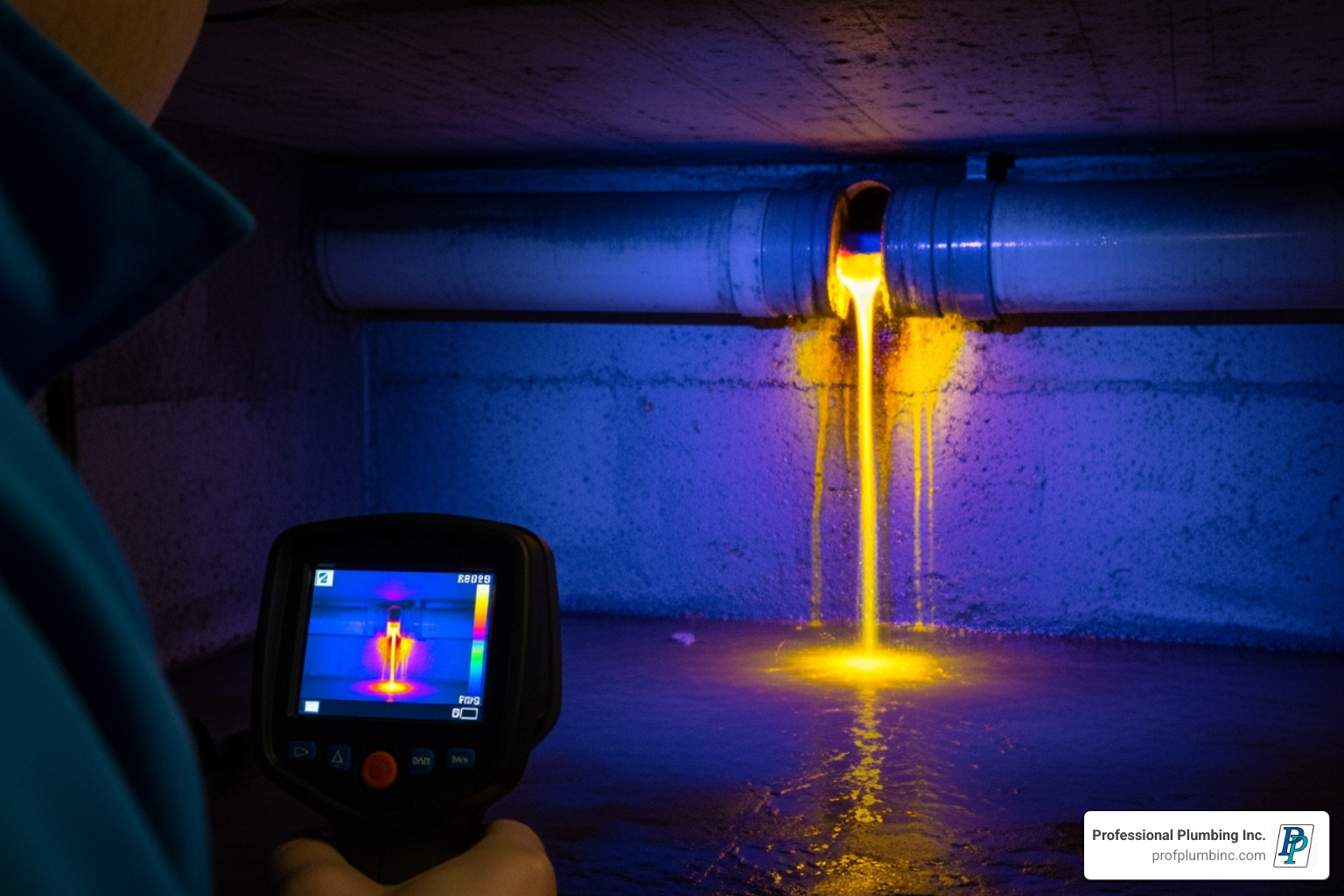
At its core, thermal imaging leak detection is about “seeing” heat. Or, more accurately, seeing the absence or presence of heat in unexpected places. Every object emits infrared energy, which we perceive as heat. A thermal imaging camera, sometimes called an infrared (IR) camera, doesn’t see visible light; instead, it detects this infrared energy and translates it into a visual image, often using false-color images to represent different temperatures. Cooler areas might appear blue or purple, while warmer areas are red or yellow.
When water leaks behind a wall, under a floor, or within a ceiling, it creates distinct temperature differences—or temperature differentials—compared to the surrounding dry materials. For instance, evaporating water draws heat from its surroundings, causing a cool spot. Conversely, a hot water leak will create a noticeable warm spot. Our thermal cameras capture these subtle variations, revealing the presence and even the path of hidden moisture. This non-invasive technology allows us to literally “see the unseen,” pinpointing the exact location of the leak without ever needing to break open walls or floors “on suspicion.”
The Science Behind the Scan
The magic behind thermal imaging lies in how water interacts with its environment. When water escapes a pipe or fixture, it affects the thermal properties of the surrounding materials in a few key ways:
- Evaporative Cooling: Water that evaporates from a surface draws heat away, making that area cooler than the dry surroundings. This is a primary indicator for many types of leaks.
- Heat Capacitance/Conduction: Water has a different heat capacity and conductivity than common building materials like drywall or wood. A pocket of water will absorb or release heat differently, creating a thermal signature. Hot water, especially from a leak, will conduct its heat into the surrounding materials, making them warmer.
- Insulation Degradation: When insulation gets wet, its insulating properties diminish. This can lead to heat loss or gain through that section of the wall or ceiling, which a thermal camera will easily pick up.
Our specialized thermal imagers detect these subtle temperature shifts. They don’t directly “see” the water, but rather the thermal impact the water has on the surface. These processes can be affected by external factors like weather conditions or interior humidity, which our experienced technicians take into account during their assessment. This scientific approach means we can accurately identify leaks or water damage by interpreting these thermal patterns and temperature anomalies.
Why It’s Perfect for Costa Mesa Homes
Costa Mesa homes, particularly in established neighborhoods like Mesa Verde and the Eastside, often present unique challenges for leak detection. Many of our local homes are built with slab foundations, meaning plumbing lines are embedded directly within the concrete. Stucco exteriors are also common, which can retain moisture differently than other siding types. Our coastal-adjacent climate can also influence how moisture manifests and is detected.
Older plumbing systems, often 40-60 years old in some of our more established neighborhoods, are more susceptible to leaks due to age and corrosion. The shifting of concrete slabs or even vibrations from local traffic can put pressure on these pipes, leading to slab leaks. For example, in many parts of Costa Mesa where homes feature slab-on-grade foundations, thermal imaging is invaluable for pinpointing leaks without destructive exploration.
Thermal imaging leak detection is perfectly suited for these local conditions because:
- It allows us to scan large areas quickly and precisely, even through dense materials like concrete and stucco.
- It’s non-invasive, preserving your home’s structure and value, which is particularly important for homes with custom finishes or historical significance, such as those in the charming Freedom Homes tract or near the Segerstrom Center for the Arts.
- It provides clear, vivid false-color images that make the reliable and centimeter-perfect location of egression points possible, avoiding unnecessary repairs and preserving your investment.
The Advantages of Thermal Imaging Leak Detection Over Traditional Methods
When it comes to finding hidden leaks, the contrast between thermal imaging leak detection and traditional methods is stark. For decades, homeowners and plumbers relied on a process that was often invasive, time-consuming, and ultimately, costly. Today, we have a better way.
The key advantages of thermal imaging include:
- Non-invasive: No need to cut into walls or flooring.
- Accuracy: Pinpoints the exact location of the leak.
- Speed: Detects issues much faster than traditional methods.
- Cost-savings: Reduces repair costs and prevents further damage.
- Damage Prevention: Avoids unnecessary demolition and reconstruction.
- Guesswork Elimination: Provides clear visual evidence, removing speculation.
Modern Technology vs. Old-School Guesswork
Imagine finding a mysterious water stain on your ceiling in your Costa Mesa home. With traditional methods, a plumber might have to cut several exploratory holes in your ceiling or walls, hoping to stumble upon the source. This is not only messy and disruptive, but it often leads to unnecessary damage and extended repair times.
Our non-invasive approach, utilizing advanced thermal cameras, means we don’t need to cut into walls or flooring. Instead, we scan the surface, and the thermal camera immediately reveals the temperature anomalies caused by the hidden leak. This preserves your investment while resolving issues efficiently.
Here’s a quick comparison:
| Feature | Thermal Imaging Leak Detection | Traditional Methods |
|---|---|---|
| Invasiveness | None | High (cutting, digging) |
| Accuracy | Pinpoint | General Area (guesswork) |
| Speed | Hours | Days |
| Collateral Damage | Minimal | Significant |
| Disruption | Low | High |
Pinpointing the Exact Source of the Leak
One of the most remarkable benefits of thermal imaging is its ability to provide a centimeter-perfect location for the egression point of a leak. By visualizing the temperature signature, our technicians can trace the moisture to its precise origin.
This precision is invaluable for various types of leaks common in Costa Mesa:
- Plumbing Leaks: Whether it’s a pipe behind a wall in your Mesa del Mar home or a mysterious drip under the concrete slab in College Park, thermal imaging reveals the exact spot. It helps us differentiate between a plumbing leak and other moisture sources. Learn more about our specialized services: Plumbing Leak Detection Costa Mesa.
- Roof Leaks: After a rainy season, a roof leak might be evident, but finding the exact entry point can be tricky. Thermal imaging can show where water has penetrated the roof structure and soaked insulation.
- HVAC Issues: Infrared scanning can even uncover insulation gaps and HVAC inefficiencies that contribute to high energy bills, not just water leaks.
- Insulation Gaps: Beyond water, thermal imaging helps identify areas of poor insulation, leading to better energy efficiency for your home.
Detecting leaks early prevents structural deterioration, mold growth, and water damage. Our process minimizes disruption by avoiding demolition or guesswork during diagnosis, saving you time, money, and stress.
What to Expect During a Professional Thermal Imaging Leak Detection Inspection
When you suspect a hidden leak, calling in the professionals is the smartest move. Here’s what you can expect when our team arrives for a thermal imaging leak detection inspection.

Our comprehensive service involves several key steps:
- Initial Consultation: We start by listening to your concerns and gathering information about the suspected leak, including any signs you’ve noticed, like high water bills or damp spots.
- Property Scan: Our technician will then use a professional-grade, high-resolution thermal camera to carefully scan the walls, ceilings, and floors in the suspected areas. This allows us to quickly identify any thermal anomalies.
- Anomaly Identification: The thermal camera will display these temperature differences as color patterns. Cool spots often indicate evaporating moisture or cold water intrusion, while warm spots can signal a hot water leak or issues with radiant heating.
- Moisture Meter Confirmation: While thermal cameras are excellent at identifying temperature differentials, they don’t directly “see” water. Therefore, any areas showing thermal anomalies are then confirmed with a digital moisture meter. This step is crucial to verify the actual presence of water and rule out other potential causes for temperature variations.
- Detailed Reporting: Once the leak is confirmed and precisely pinpointed, we provide you with a comprehensive report.
The Process of a Professional Service
Our skilled plumbers are trained not just in operating the advanced equipment, but also in interpreting the subtle nuances of thermal images. They understand how factors like environmental conditions, building materials, and even the time of day can affect readings.
During the scan, our technicians will:
- Prepare the Area: We ensure the space is ready for an accurate scan, which might involve adjusting indoor temperatures slightly to create a clearer thermal contrast.
- Conduct the Scan: Using specialized techniques, we sweep the thermal camera across surfaces, looking for the characteristic patterns of moisture. For instance, moisture in walls typically forms a top-down triangular shape, while ceiling moisture often appears as amorphous, unstructured shapes. Hot water pipe leaks are clearly identifiable as warm areas.
- Cross-Reference with Other Tools: For complex cases, we might also employ other non-invasive tools, such as acoustic sensors (which listen for the sound of escaping water) or pressure testing, to ensure complete coverage and accuracy.
- Confirm and Document: Every suspected leak identified by the thermal camera is verified with a moisture meter. We then document the findings with both thermal and standard digital photographs, noting the exact location and extent of the moisture.
Understanding the Final Report
Following the inspection, you’ll receive a comprehensive report that is easy to understand. This report will include:
- High-resolution thermal images clearly showing the identified anomalies.
- Standard digital photographs of the affected areas.
- A detailed description of our findings, including the type of leak (e.g., hot water, cold water, roof leak) and the extent of moisture.
- The exact, pinpointed location of the problem, often within a centimeter.
This detailed reporting allows for targeted, efficient repairs. You’ll know precisely where the problem is, enabling us to perform minimal demolition and significantly reduce restoration costs. This transparency is part of our commitment to honest, upfront service. Learn about our slab leak detection services for more details on specific applications.
The Right Tools and Local Expertise for the Job
Successfully leveraging thermal imaging leak detection isn’t just about having the technology; it’s about wielding it with expertise. At Professional Plumbing Inc., we pride ourselves on combining state-of-the-art equipment with the deep local knowledge and certified skills of our technicians.
Why Professional Equipment and Local Knowledge Matter
Not all thermal cameras are created equal. While consumer-grade thermal cameras are available, professional leak detection demands much more. We invest in high-resolution cameras with exceptional thermal sensitivity (a low NETD, ideally 30mK or lower). This allows us to detect the most subtle temperature differences—the tiny thermal signatures that indicate hidden moisture—which consumer devices often miss. Brands like FLIR, renowned for their precision, are trusted by professionals like us. Their advanced cameras, such as the FLIR E6 Pro or E8 Pro, are specifically designed for building inspections and moisture detection.
Our technicians undergo rigorous thermography training through recognized institutions like the Infrared Training Center. This specialized training ensures they are not just operating a camera, but expertly interpreting the complex thermal patterns and anomalies they encounter. They understand how factors unique to Costa Mesa, such as the varied building materials found in homes from the Westside to Eastside Costa Mesa, or the coastal climate affecting humidity levels, influence thermal readings.
Our years of experience serving Costa Mesa homes mean we understand the local plumbing infrastructure, common leak points in different home styles (from the classic ranch-style homes in Mesa Verde to the unique properties in the Freedom Homes tract), and even local building codes. This local knowledge, combined with professional equipment and certified skills, ensures we provide the most accurate and reliable service.
How Accurate is Thermal Imaging Leak Detection?
When performed by trained technicians, thermal imaging leak detection is extremely accurate. It’s a precise, non-invasive method that helps us locate leaks with remarkable reliability. However, like any advanced tool, its effectiveness depends on certain conditions and the skill of the operator.
Key factors influencing accuracy include:
- Temperature Conditions: A significant temperature difference between the leaking water and the surrounding environment, or between the inside and outside of a structure, helps our cameras capture clearer images. For instance, a cold water leak is easier to spot on a warm wall.
- Material Properties: Different building materials have varying thermal properties. Our technicians understand how these materials absorb and conduct heat, which aids in accurate interpretation.
- Expert Interpretation: The ability to distinguish between a thermal anomaly caused by a leak and one caused by structural elements, insulation gaps, or even ambient conditions is crucial. Our certified technicians are trained to make these critical distinctions.
While thermal imaging provides invaluable insights, it detects temperature differences, not water directly. That’s why we always confirm our thermal findings with a digital moisture meter. This two-pronged approach ensures you get the most reliable results, giving you peace of mind that we’ve found the true source of your leak.
Frequently Asked Questions about Thermal Imaging Leak Detection
We understand that homeowners have many questions about this advanced technology. Here are some of the most common inquiries we receive:
Can thermal imaging find a leak under a concrete slab?
Absolutely, yes! In Costa Mesa, many homes, especially in neighborhoods like Mesa Verde, Halecrest, and College Park, are built on concrete slabs. Leaks under these slabs—known as slab leaks—can be incredibly destructive and difficult to find using traditional methods. Thermal imaging leak detection is one of the most effective ways to locate them without resorting to extensive, costly demolition.
Here’s how it works:
- Hot Water Lines: If a hot water line is leaking under the slab, the escaping warm water will heat the concrete above it, creating a distinct warm spot on your floor. Our thermal camera will clearly show this as a bright area on the thermal image.
- Cold Water Lines: Conversely, a cold water leak can cause a cool spot on the floor due to the cooler water being introduced to the warmer slab, or through evaporative cooling if the water is surfacing.
By identifying these thermal signatures, we can pinpoint the exact location of the leak, often within a centimeter, allowing for targeted repairs that minimize disruption to your home. This avoids the old method of breaking open large sections of concrete just to find a tiny pinhole leak.
How often should I have my property inspected?
For most Costa Mesa homes, an annual inspection using thermal imaging is a smart preventative step. This is especially true for homes over 20 years old, or if you notice an unexplained increase in your water bill. Our local climate, with its coastal humidity and occasional temperature swings, can put stress on plumbing systems, making regular checks a good idea.
Regular thermal imaging helps catch small leaks before they escalate into major problems, preserving your property’s value and reducing utility expenses. Detecting leaks early prevents structural deterioration, mold growth (which can be a significant health hazard), and extensive water damage. Think of it as a routine check-up for your home’s hidden plumbing—proactive maintenance for peace of mind.
Is thermal imaging expensive?
While there is a cost associated with a professional thermal imaging leak detection service, it’s almost always a far more affordable and less stressful option than dealing with the aftermath of an undetected leak. Consider the potential costs of not using thermal imaging:
- Blind Demolition: Cutting into walls, ceilings, or floors “on suspicion” to find a leak.
- Extensive Repairs: The cost of repairing not just the pipe, but also the drywall, flooring, paint, and potentially structural elements.
- Mold Remediation: If moisture leads to mold growth, remediation can be extremely expensive and disruptive.
- Higher Utility Bills: Undetected leaks can significantly drive up your water bill over time.
- Property Value Loss: Structural damage and mold can decrease your home’s value.
Compared to these potential expenses, the cost of a non-invasive thermal inspection that accurately pinpoints the problem from the start is an investment that saves you money, time, and hassle in the long run. Our non-invasive approach means we don’t need to cut into walls or flooring, preserving your investment while resolving issues efficiently.
Protect Your Costa Mesa Home with Expert Leak Detection
A hidden leak is more than a nuisance—it’s a silent threat to your home’s structure, your family’s health, and your finances. Thermal imaging leak detection is the fastest, most accurate, and least destructive way to unmask these hidden problems. By catching leaks early, you prevent costly water damage, stop mold before it starts, and protect your property’s value.
With over 40 years of experience serving homeowners throughout Costa Mesa, from the Westside neighborhoods to the Eastside, the skilled plumbers at Professional Plumbing Inc. use state-of-the-art thermal technology to provide honest, upfront, and hassle-free solutions. We’re deeply familiar with the nuances of Costa Mesa homes, from the coastal-influenced properties near the Upper Newport Bay to the established neighborhoods around Orange Coast College. Our guaranteed workmanship ensures fast, clean, and reliable results for all your plumbing needs.
Don’t wait for a small drip to become a disaster. Contact us today to schedule your non-invasive thermal imaging inspection!