
Electric Continuous Hot Water System: 1st for Endless Comfort
Your Guide to Modern Electric Water Heaters in Orange County
An electric continuous hot water system heats water on demand without storing it in a tank, providing endless hot water while saving energy and space. Here’s what you need to know:
Quick Answer: Electric Continuous Hot Water Systems
- What it is: An on-demand water heater that heats water instantly as it flows through electric elements
- Key benefits: Never run out of hot water, no standby energy loss, compact wall-mounted design
- Best for: Smaller Orange County homes, ADUs, and properties without gas lines
- Key consideration: Requires significant electrical capacity (often 100-200 amps)
- Alternative: Heat pump systems use less electricity but need more space and cost more upfront
If you’re tired of running out of hot water during morning showers or watching your energy bills climb from an old tank heater, you’re not alone. Many Orange County homeowners are exploring electric water heating options, especially as cities like Huntington Beach and Newport Beach gradually shift away from natural gas in new construction.
The choice isn’t always simple. While electric continuous flow systems promise endless hot water in a compact package, heat pump water heaters offer the lowest operating costs available today. Some families in Fountain Valley and Costa Mesa need the space savings of a tankless unit, while others prioritize long-term energy efficiency.
The reality? There’s no one-size-fits-all answer. Your home’s electrical capacity, your family’s hot water usage, available space, and budget all play a role in finding the right solution.
I’m William Horsky, and in my 42 years as a master plumber serving Orange County, I’ve installed hundreds of water heating systems and helped families steer the shift from traditional tanks to modern electric continuous hot water systems and heat pumps. Whether you’re remodeling a Garden Grove bathroom or adding an ADU in Costa Mesa, I’ll walk you through what actually matters when choosing your next water heater.

How an Electric Continuous Hot Water System Delivers Endless Comfort
Have you ever wondered how an electric continuous hot water system can give you hot water on demand without a bulky tank eating up space in your Huntington Beach or Costa Mesa garage? It is quite clever. These systems, often called tankless or instantaneous water heaters, work fundamentally differently from the traditional tank models many of us grew up with in older OC homes.
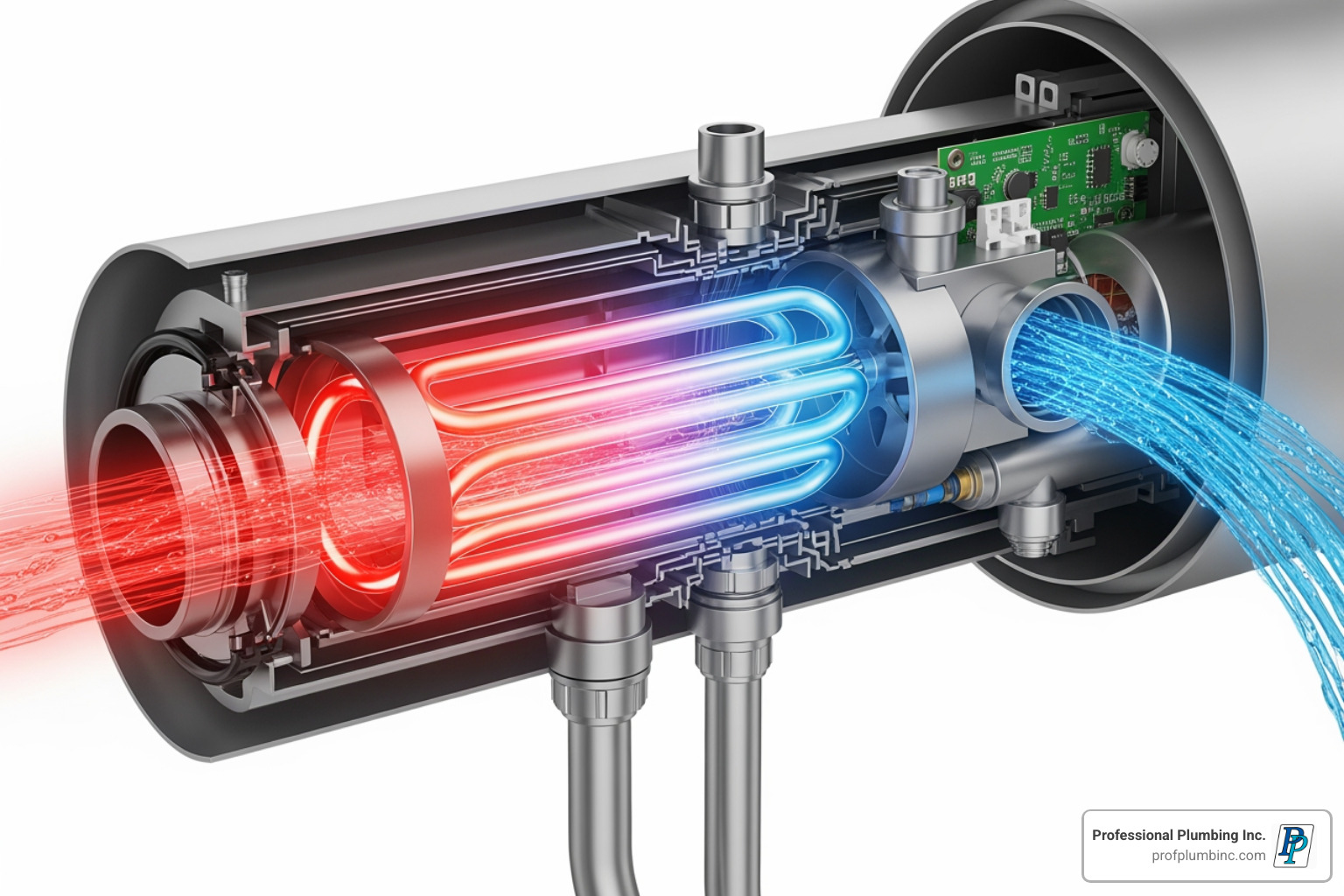
When you turn on a hot water tap in your Huntington Beach home near Main Street or a Costa Mesa townhouse by The Camp, a flow sensor inside the unit detects the movement of water. This triggers powerful electric heating elements to activate. As cold water flows through the system, it passes over these super-heated elements, instantly raising its temperature to your desired setting. It is truly “on-demand” heating – the water is only heated as it is needed.
This mechanism is the secret to why you will practically never run out of hot water with an electric continuous hot water system. Unlike a conventional tank heater that stores a finite amount of hot water, these systems continuously heat water as long as your tap is open. That means no more cold surprises during your morning shower, even if someone else is running the dishwasher in a Newport Beach kitchen or the washing machine in a Fountain Valley laundry room.
Another significant benefit of this on-demand approach is the elimination of standby heat loss. Traditional tank heaters constantly work to keep a large volume of water hot, 24/7, even when you are at work in the Irvine business district or at a game at Angel Stadium. This leads to energy waste. Since an electric continuous hot water system only heats water when called for, there is virtually no energy lost to keeping water warm in a tank. Over time, that can translate into noticeable energy savings for Orange County homeowners on Southern California Edison bills.
In local practice, we see this especially in compact homes and ADUs around Garden Grove and Westside Costa Mesa, where a tankless unit mounted on an exterior wall frees up storage space while still delivering comfortable, consistent hot water to showers and fixtures throughout the house.
The Great Debate: Continuous Flow vs. Heat Pumps in Orange County
When it comes to modern electric water heating in Orange County, the discussion often boils down to two main contenders: the electric continuous hot water system and the heat pump water heater. Both offer significant advantages over old tank-style electric heaters, but they achieve their efficiency in different ways.
If you live in Huntington Beach, Fountain Valley, Costa Mesa, Garden Grove, or Newport Beach, the right choice often comes down to your available space, electrical panel size, and how your family uses hot water.
| Feature | Electric Continuous Hot Water System | Heat Pump Water Heater |
|---|---|---|
| Upfront Cost | Moderate to High | High |
| Running Cost | Moderate (lower than tank, higher than heat pump) | Lowest (most energy-efficient) |
| Energy Efficiency | High (no standby loss) | Very High (uses ambient air, not direct electricity) |
| Size/Space | Very Compact (wall-mounted) | Large (similar to traditional tank) |
| Lifespan | 20+ years | 10-15 years |
| Installation | Significant electrical upgrade often required | Electrical upgrade, adequate space needed |
The Case for an Electric Continuous Hot Water System
For many Orange County residents, the electric continuous hot water system is a game-changer, especially where space is at a premium or gas lines are not an option.
Around Huntington Beach, we often see this in older homes near Five Points and beach cottages closer to PCH, where garages are tight. In Costa Mesa, ADUs tucked behind homes near 17th Street are perfect candidates.
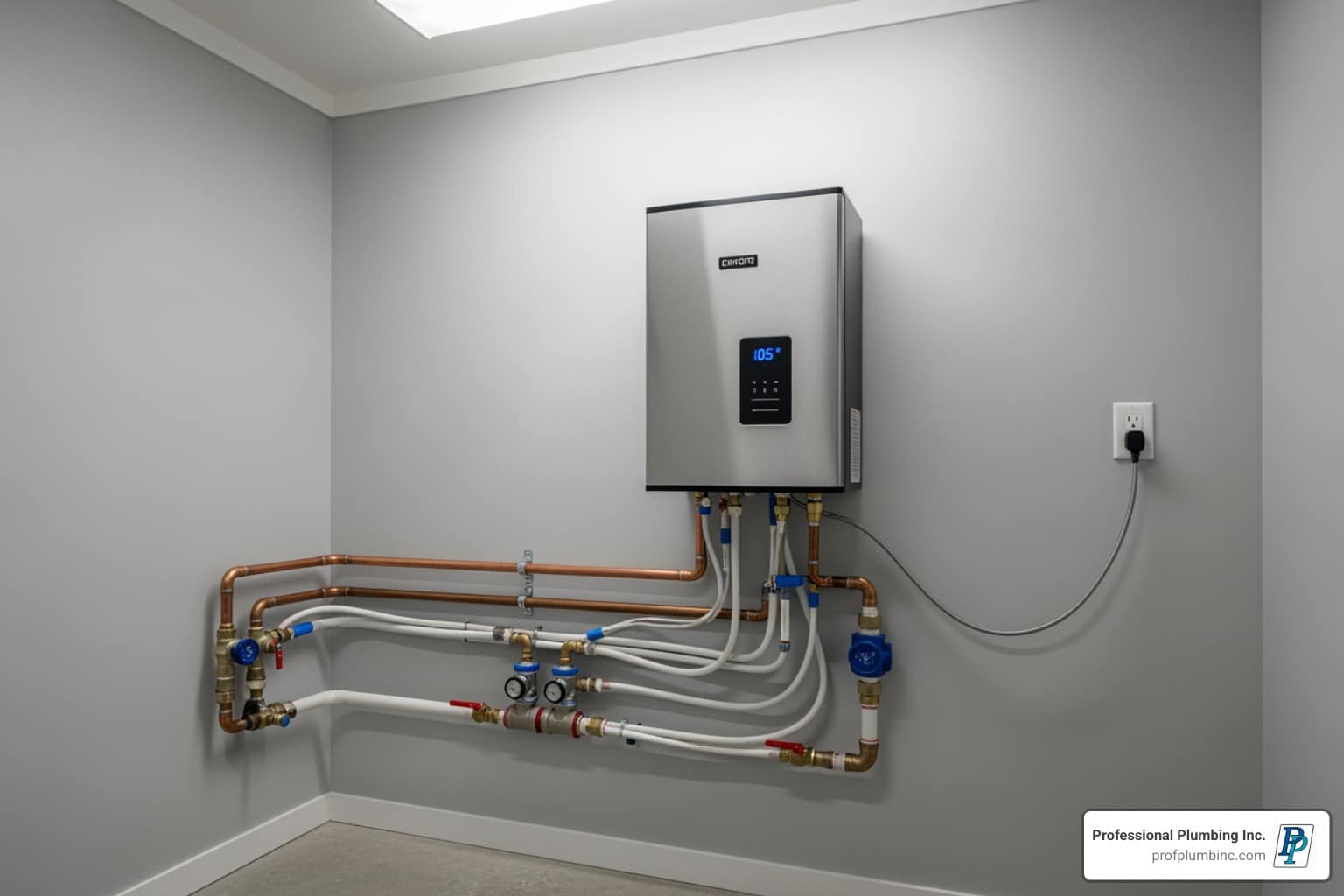
The most compelling advantage is its incredibly compact design. These units mount on a wall, freeing up valuable floor space. We have installed them in closets, utility rooms, and even under sinks for point-of-use applications.
The promise of endless hot water is another major draw. Never rush a shower before school drop-off at Fountain Valley High or Marina High. With an electric continuous hot water system, as long as electricity flows, you have hot water.
From an energy efficiency standpoint, these systems eliminate standby heat loss. Since they only heat water when needed, there is no energy wasted keeping a tank hot around the clock.
However, the primary drawback is high electrical demand. These units often need dedicated 240-volt circuits and high amperage. In many Huntington Beach and older Costa Mesa homes built in the 1960s with 100-amp panels, this might necessitate an electrical panel upgrade.
Another consideration is flow rate limitations. While they provide endless hot water, if too many fixtures run simultaneously, the system might struggle to maintain temperature at all outlets. We have helped countless homeowners understand these nuances. More info about our water heater services is available here.
Why Your Newport Beach Neighbors Might Choose a Heat Pump
While electric continuous hot water systems offer great benefits, heat pump water heaters are often the most energy-efficient electric option available. If energy savings are your top priority and you have space, a heat pump might be best.
We commonly recommend heat pump water heaters for:
- Larger homes in Newport Coast with roomy garages
- Family houses in Fountain Valley near Mile Square Park
- Garden Grove homes where owners want the lowest electric costs
Heat pump water heaters work like a refrigerator in reverse, drawing heat from surrounding air and transferring it to water. This makes them incredibly efficient – for every unit of electricity consumed, they produce two to three units of heat energy.
This efficiency translates into the lowest operating costs among electric water heaters. While upfront costs are typically higher, long-term savings on energy bills can be substantial.
Various government rebates and incentives are available for heat pump water heaters. Programs at federal, state, and local levels can significantly offset the initial price. You can often Find out about clean energy incentives through utility providers.
The main drawbacks are their larger physical footprint and requirement for ample clearance. They operate best in unconditioned spaces with consistent ambient temperatures, like a garage in Costa Mesa.
The Verdict for Your OC Home
Which electric water heater is right for your Orange County home? There is no single “best” option; it depends on your specific circumstances.
If space is critical, perhaps in a Balboa Island condo or Garden Grove ADU, an electric continuous hot water system offers the best compactness. It also guarantees endless hot water.
If you have adequate space and prioritize lowest long-term operating costs, a heat pump water heater is likely your champion. The higher upfront cost is often recouped through significant electricity bill savings.
Consider your household size and hot water usage. A small Costa Mesa townhouse might find a smaller electric continuous hot water system sufficient, while a large Newport Beach family might benefit from a heat pump’s high-volume, low-cost operation.
The best system matches your lifestyle, budget, and home’s infrastructure. At Professional Plumbing Inc., we evaluate your panel size, plumbing layout, and distance to fixtures before making recommendations.
Sizing and Installation: What Your Home Needs for an Upgrade
Choosing the right type of electric water heater is just the first step. The next crucial phase involves proper sizing and professional installation. This is where our expertise at Professional Plumbing Inc. truly comes into play, ensuring your system performs optimally for years to come in real Orange County conditions.
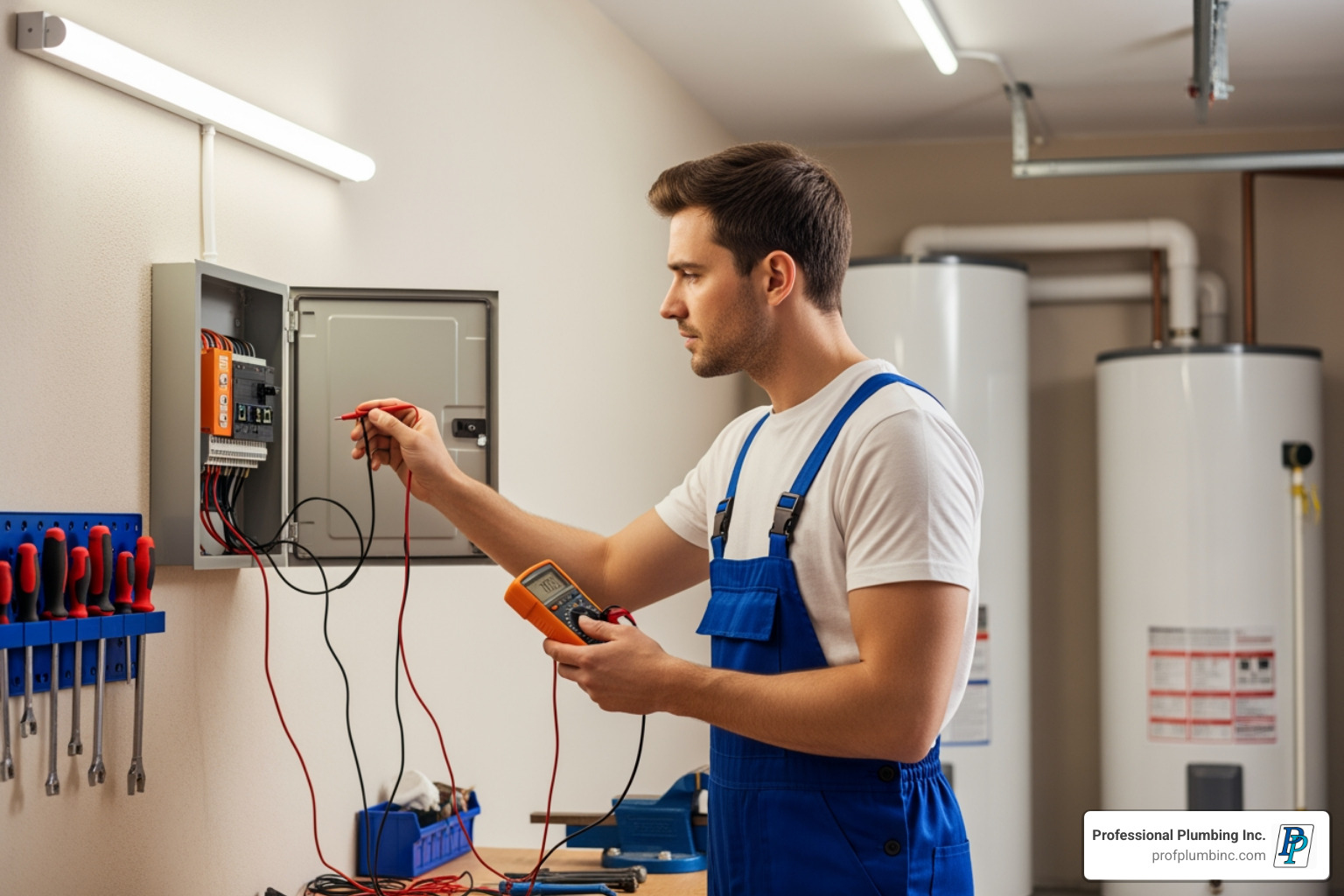
We regularly see undersized or incorrectly wired units in Huntington Beach, Fountain Valley, and Garden Grove homes when someone tried a DIY installation or hired a contractor unfamiliar with the electrical demands of whole-house electric tankless systems. Correct sizing and panel evaluation up front prevents nuisance breaker trips and lukewarm showers later.
Choosing the Right Size: Flow Rate & Temperature Rise
When selecting an electric continuous hot water system, you cannot just pick one off the shelf. Key factors to consider are flow rate, wattage, and voltage. These elements determine how much hot water the unit can produce and how quickly.
The most important metric for an electric continuous hot water system is its flow rate, measured in Gallons Per Minute (GPM). This tells you how many gallons of hot water the unit can deliver per minute at a specific temperature rise. To size correctly, we need to consider how many hot water fixtures you might use simultaneously in your OC home.
Here is a list of common household fixture flow rates to give you an idea:
- Shower: 1.5 – 2.5 GPM
- Faucet (kitchen/bathroom sink): 0.5 – 2.0 GPM
- Dishwasher: 1.0 – 2.0 GPM (intermittent)
- Washing Machine: 1.5 – 3.0 GPM (intermittent)
For example, if you want to run a shower (2 GPM) and a kitchen faucet (1.5 GPM) at the same time in your Huntington Beach home near Edison Park, you would need a unit capable of at least 3.5 GPM.
Another critical factor is temperature rise. This is the difference between the incoming cold water temperature and your desired hot water temperature. In colder climates, a unit needs to work harder to raise the water temperature, thus reducing its effective GPM.
Fortunately, Orange County’s groundwater temperatures are relatively mild compared to other regions, often in the 60s Fahrenheit, whether you are in Costa Mesa by the 55 freeway or inland in Anaheim. That means our electric continuous hot water systems can often achieve higher GPMs here than they might elsewhere. We always factor in our local water temperatures when making recommendations.
For a family in Huntington Beach or Fountain Valley, for instance, we will:
- Assess their daily routine (back-to-back showers, laundry timing, dishwasher use)
- Count fixtures and look at low-flow vs older showerheads
- Factor in upstairs bathrooms that might need higher flow
From there we recommend a system with adequate wattage and GPM. A unit with 27 kW or 36 kW might be suitable for a whole-home application, depending on the demand and the size of your electrical service.
Installation Requirements for an Electric Continuous Hot Water System
Installing an electric continuous hot water system is not a DIY project. It requires the expertise of a licensed plumber and often an electrician due to the significant electrical demands and local code requirements in cities like Costa Mesa, Garden Grove, and Newport Beach.
Most of these units require dedicated 240-volt circuits and can draw anywhere from 100 to 200 amps, depending on the size and capacity. This means a thorough electrical panel assessment is crucial. Many older homes across Fountain Valley, Costa Mesa, or Garden Grove were built with 100-amp panels that were never designed with a large electric tankless unit in mind.
In those cases, electrical panel upgrades might be necessary to safely accommodate the new system. We work closely with trusted local electricians who understand Orange County permitting processes, so your upgrade passes inspection the first time. We make sure your home’s electrical infrastructure can handle the load before we ever hang a unit on the wall.
Plumbing connections are straightforward but must be done precisely to prevent leaks and ensure optimal water flow. The compact size of these units allows for flexibility in installation locations. In practice, we often:
- Mount units on garage walls in Huntington Beach and Costa Mesa
- Tuck them into side-yard closets in Garden Grove
- Install them closer to the master bathroom in Newport Beach homes to reduce wait time for hot water
Locating the heater closer to the point of use, like near a bathroom vanity or kitchen, can further reduce the wait time for hot water and minimize heat loss through pipes. For comprehensive information on various water heating system types and their requirements, you can refer to resources from the U.S. Department of Energy, such as this guide to Learn about system types.
Our team at Professional Plumbing Inc. has decades of experience installing these systems across Orange County, from the coastal homes of Newport Beach and Balboa Island to the inland communities of Anaheim and Santa Ana. We ensure all installations meet local codes and safety standards, and we take the time to walk you through how your new system works before we leave.
Lifespan, Maintenance, and Long-Term Costs
Investing in a new water heating system is a significant decision for any Orange County homeowner. Understanding the expected lifespan, maintenance requirements, and long-term costs will help you maximize your investment.
In our service areas of Huntington Beach, Fountain Valley, Costa Mesa, Garden Grove, and Newport Beach, we factor in two local realities: relatively hard water and heavy year-round use due to our mild climate.
Expected Lifespan and Typical Warranties
One standout advantage of an electric continuous hot water system is its impressive longevity. While traditional tank water heaters typically last 8-12 years, tankless units often last 20 years or more. This extended lifespan comes from their design, which avoids constant heating and cooling cycles and doesn’t store water, reducing corrosion.
Heat pump water heaters generally last 10-15 years, primarily because they still rely on a storage tank and have more mechanical components that can wear out.
When considering a purchase, always check the warranty. Most reputable manufacturers offer strong warranties on electric continuous hot water systems, often covering the heat exchanger for 10-15 years and parts for 5 years.
Maintenance to Maximize Your Investment
Even advanced water heaters require maintenance for peak performance. For electric continuous hot water systems, the most critical task in Orange County is descaling or flushing.
Our local water has high mineral content, especially in Garden Grove, Anaheim, and parts of Fountain Valley. Over time, calcium and magnesium can build up inside heating elements and pipes, reducing efficiency.
We recommend annual descaling to remove mineral deposits. This involves circulating a vinegar solution or descaling agent through the unit. In homes closer to the beach in Huntington Beach or Newport Beach, we adjust maintenance intervals based on water test results.
For heat pump water heaters, maintenance includes checking air filters and occasionally checking the anode rod to prevent corrosion.
Regular professional service ensures your water heater operates efficiently. Our team at Professional Plumbing Inc. can set up an annual maintenance schedule. We keep records of your unit, so when we return to a home in Costa Mesa or Garden Grove, we know the model, age, and previous service work.
Comparing Costs: Upfront vs. Lifetime Savings
When evaluating water heater costs, look beyond the initial purchase price. Consider total lifetime cost, including purchase, installation, and operational expenses.
An electric continuous hot water system typically has a higher upfront price than conventional electric tank heaters. Installation costs can be higher if electrical upgrades are needed. However, long-term savings come from energy efficiency, eliminating standby heat loss.
For homes using 41 gallons of hot water daily or less, tankless heaters can be 24-34% more energy efficient. Even for homes using 86 gallons daily, they can be 8-14% more efficient.
Heat pump water heaters have the highest upfront costs but offer the lowest operating costs, using about a third of the energy of electric storage systems.
In practical terms for Orange County households:
- Lower monthly SCE bills for Fountain Valley families running multiple showers
- Faster payback periods in larger Newport Beach homes with high hot water demand
Federal tax credits and local rebates can help offset initial investments. We encourage customers in Anaheim, Tustin, and Costa Mesa to explore these incentives. When we visit your home, we can point you toward current programs and help you understand which models qualify.
Ready for an Upgrade? Let’s Find Your Perfect Hot Water Solution
Choosing the right hot water system for your Orange County home is a decision that impacts your daily comfort, energy bills, and environmental footprint for years to come. Whether it is the compact, endless hot water of an electric continuous hot water system or the ultra-efficient, low-operating-cost performance of a heat pump water heater, the best system is truly the one that aligns with your specific needs, budget, and home’s infrastructure.
Our team works every day in Huntington Beach, Fountain Valley, Costa Mesa, Garden Grove, Newport Beach, and surrounding neighborhoods. We know the common floor plans, typical electrical panel sizes, and even how far the garage is from upstairs bathrooms in many local tracts. That local experience helps us recommend systems that actually work for your home, not just on paper.
Professional Plumbing Inc. has been dedicated to helping Orange County homeowners for over 40 years. Our expertise in plumbing repair and installation means we can provide honest, upfront pricing and skilled, guaranteed workmanship for all your water heating needs.
From assessing your electrical capacity in Irvine or Anaheim, to determining the ideal flow rate for your family in Fountain Valley or Costa Mesa, to solving long waits for hot water in Huntington Beach or Garden Grove, we are here to guide you every step of the way. We pride ourselves on fast, clean, and hassle-free solutions, ensuring you get the hot water comfort you deserve.
Ready to explore your options or need expert advice custom to your specific neighborhood and home?
Contact our Huntington Beach plumbers for a free consultation
We also serve these wonderful Orange County communities:
- Fountain Valley Plumber
- Garden Grove Plumber
- Costa Mesa Plumber
- Newport Beach Plumber
- Anaheim Plumber
- Irvine Plumber
Whether you are near South Coast Plaza, along Beach Boulevard, close to Newport Harbor, or in a quiet Garden Grove cul-de-sac, we can help you choose and install the right electric water heating solution for your home.