
Cast Iron Pipe Replacement in Costa Mesa Homes
Last updated on September 27, 2026 by William J. Horsky Jr.
The tub takes a little longer to drain every month, and nothing you pour down it helps. In an older Costa Mesa home, that often points to aging cast iron drains. Cast iron pipe replacement rarely means putting new cast iron back in. Most drain lines below ground switch to ABS plastic. Cast iron stays only where noise control or code calls for it.
Key Takeaways
- Most cast iron drains below ground or under the slab get replaced with ABS plastic.
- Cast iron stays in upstairs drain lines because it's much quieter than plastic.
- Drains that pass through the garage firewall need cast iron or steel.
- Under-slab replacement costs more mainly because of the labor to reach the pipe.
- A raised-foundation home usually costs less than a slab home for the same drain.
Where Cast Iron Still Belongs in a Home
Cast iron drain pipe still has one job it does better than anything else in a house: keeping drains quiet. It absorbs the sound of water falling through it. That's why you'll find it where drains drop from a second floor past bedrooms and living rooms. Plumbers still reach for it on upstairs work today.
Cast iron drain pipe. Cast iron drain pipe is heavy iron pipe that carries waste water from sinks, tubs, and toilets toward the sewer. Today it's used mainly to keep upstairs drains quiet and for commercial work.
ABS plastic, by contrast, carries the sound of every flush through the wall. According to the Cast Iron Soil Pipe Institute, a cast iron system tests about 10 decibels quieter than an all-plastic one. The group describes that as twice as quiet. As a result, many higher-end two-story homes run cast iron from the second floor down to the first floor.
Many Costa Mesa homes are older, too. The city's 2013–2021 Housing Element reported that 79% of owner-occupied homes were built before 1980. Homes from the 1950s commonly used cast iron for the larger drain lines. Those lines are now decades into their service life, so cast iron pipe replacement comes up often here.
Why Most Cast Iron Replacements Switch to ABS
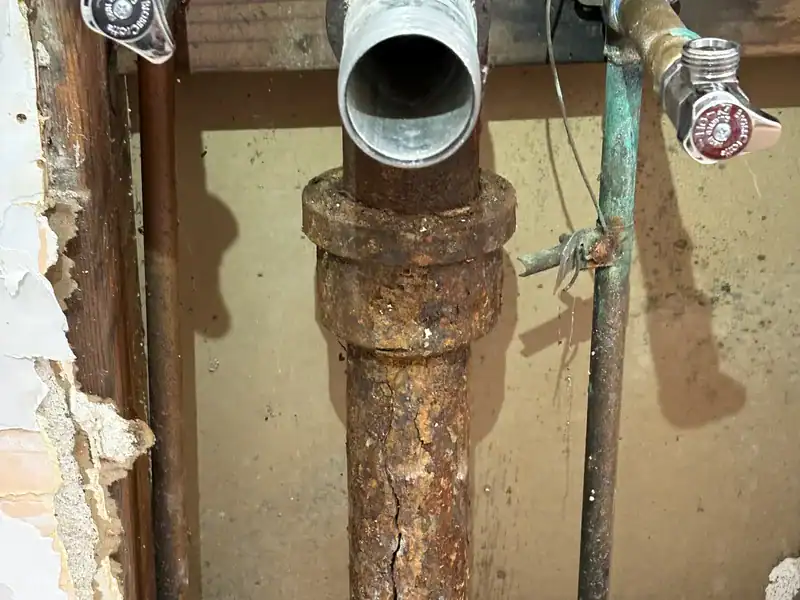
When a cast iron drain below the first floor fails, we almost always replace that section with ABS, the black plastic drain pipe. Below ground and under the slab, nobody hears the water moving. The quiet of cast iron buys you nothing there. Meanwhile, ABS costs far less to buy and to install, which makes it the sensible choice for buried drains.
A few pipe names get mixed up in quotes. We use ABS for drains, not PVC, which is the white plastic pipe. PEX is flexible tubing for water supply lines, and it's never used for drains. So if a quote lists PEX for a drain line, ask the plumber to explain it before you sign.
ABS also has a height limit in homes. A California amendment to the plumbing code limits ABS and PVC drain piping to two stories of living space. In a three-story home, then, part of the drain system has to be metal pipe, usually cast iron. Upstairs in a two-story home, the choice is case by case, weighing noise, access, and cost.
Where code calls for cast iron or steel
Some spots in a house call for metal pipe. The wall and ceiling between an attached garage and the living space form a fire separation, usually called the firewall. Some drains pass through that firewall into the house or into a utility closet, such as a water heater closet. At those spots, we use cast iron or steel, not ABS. The same goes for drain lines that run exposed across a garage ceiling.
How Long Do Cast Iron Drain Pipes Last?
Cast iron drain pipes usually last 50 to 60 years below ground and about 60 years above ground, according to InterNACHI's life expectancy chart. That puts the original drains in a 1950s or 1960s Costa Mesa home at or past that range today. Age alone doesn't mean a pipe has failed, though. The camera shows the real condition.
Signs your cast iron drains are wearing out
Cast iron wears from the inside: as the pipe ages, its inside wall turns rough. That rough surface snags solids and paper on their way down the line. The result is a drain that slows down over months rather than one that stops all at once. In fact, slow drains in more than one fixture are usually the first thing homeowners notice.
You may have aging cast iron drains if you notice any of the following:
- Several drains in the house slowing down over time, not just one
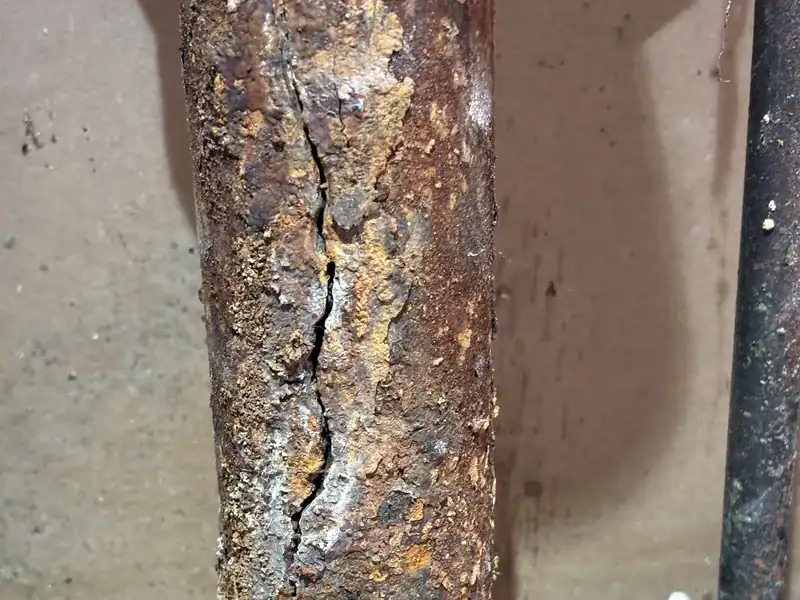
- A rust line or crack along a vertical drain pipe you can see in the garage or a closet
- Water stains on a ceiling below an upstairs bathroom
From William J. Horsky Jr.:
"Over the last five years, my guys have seen a huge increase in cracked vertical stacks. Those are the drain pipes that run straight down from a second or third floor. These aren't pinholes. The crack often runs the full length of the pipe."
What Drives Cast Iron Pipe Replacement Cost
Cast iron pipe replacement cost depends less on the pipe than on reaching it. Three variables matter most: the material we put back, where the pipe runs, and how much of the house we have to open and restore. Every cast iron pipe replacement gets a written price before any repair work begins. The price names each variable, so you can see what's driving the number.
What the pipe itself costs
Cast iron pipe costs about 52% more than ABS at retail, before you add anything to join it. Every cast iron joint also needs a no-hub band, a stainless steel clamp with a rubber sleeve. By contrast, an ABS joint is glued, with a few cents' worth of cement. So the real material gap is wider than the pipe prices alone.
Retail prices for 4-inch drain pipe and joints
ABS joints are glued, so they add pennies per joint instead of a band. Local Lowe's shelf prices checked September 27, 2026: ABS pipe, cast iron pipe, no-hub band.
Labor widens the gap again. Cast iron is heavy and every joint gets a band tightened by hand, so it takes our plumbers roughly 30% to 40% longer to install than ABS. On most jobs, that extra time costs more than the material difference.
Where the drain runs
| Where the drain runs | What we usually install | What moves the price |
|---|---|---|
| A small damaged section | Cast iron, or ABS tied into the cast iron | Access to the spot; small repairs usually run in the hundreds of dollars, sometimes into the low thousands |
| Under a raised foundation | ABS | Crawlspace access; noticeably less than slab work |
| Under a concrete slab | ABS | Labor to open the floor, reach the pipe, and restore the floor |
| A vertical stack from upstairs | Cast iron or ABS, case by case | Wall access; ABS costs less but carries sound |
| Through the garage firewall, or exposed in the garage | Cast iron or steel | Metal pipe is required at these spots |
Slab homes versus raised foundations
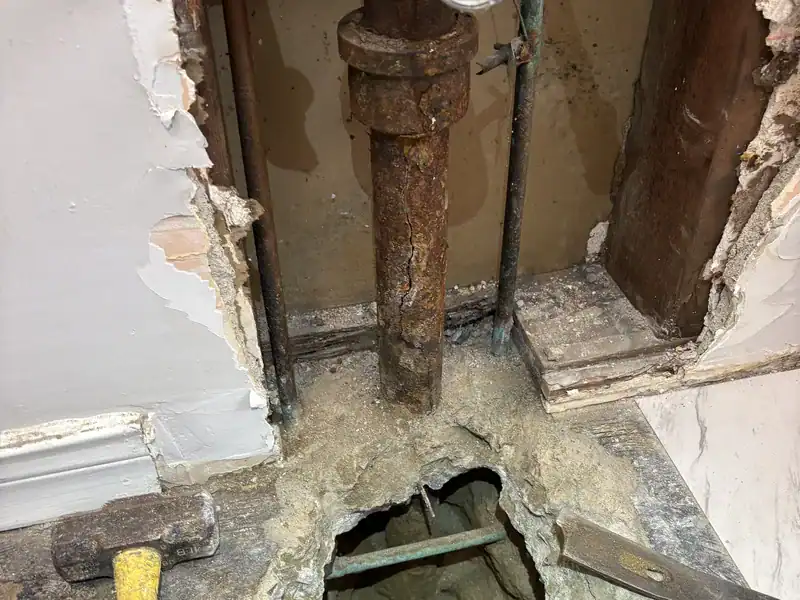
Under-slab replacement shows this best. Most of the money goes to the labor of reaching the pipe and then putting the floor back. The pipe itself is a small share. By comparison, a raised-foundation home costs noticeably less for the same drain, since our plumbers reach the pipe from underneath.
Switching a vertical stack to ABS also brings the price down. The trade-off is sound. You'll hear water running down the wall every time a toilet flushes or a tub drains upstairs. For a stack beside a bedroom, we walk through that call with you before any work starts.
Quotes for the same drain can differ widely, especially when one company prices new cast iron where code allows ABS. If you have gotten a quote for a job of $2,500 or more and would like a second opinion, we do them for free. You'll need to have a written estimate from the other company. Call or ask for details.
Do Cast Iron Drain Pipes Need to Be Replaced?
Not every cracked or corroded cast iron drain needs a full replacement. The choice depends on how much of the line is sound, where the damage is, and whether that pipe must stay metal. A camera inspection shows the inside of the line, so the answer comes from the pipe itself instead of a guess.
- Repair a section when the damage sits in one spot and the rest of the line looks sound on camera.
- Replace the run when cracks or heavy roughness show up along much of the pipe. Full-length stack cracks fall in this group.
- Replace during a remodel when walls or floors are already open near old cast iron. The access work, usually the biggest part of the cost, is already done.
- Keep it metal when the pipe passes through the garage firewall or runs exposed in the garage. Upstairs drains next to living space are a case-by-case call.
For the line that runs from the house to the street, our sewer line repair page covers the options in more detail. For clogs that keep coming back, see our drain cleaning in Costa Mesa page.
Your Sewer Lateral and the Costa Mesa Sanitary District
The sewer lateral is the drain line from your house to the sewer main, and in Costa Mesa it belongs to you. The Costa Mesa Sanitary District says property owners maintain the lateral up to the district's main line. That connection is usually in the middle of the street, and the district maintains the main line itself.
Separately, the district runs a sewer inspection rebate program for residential owners. It reimburses part of the cost of a camera inspection of the lateral or a new ground-level cleanout. You need the district's approval before the work starts. Our sewer inspection rebate page walks through how it works.
A camera inspection also shows the condition of the cast iron under the house before you decide on a cast iron pipe replacement. For a broader look at drain and sewer problems, see our drain and sewer service guide.
Frequently Asked Questions About Cast Iron Drains
Can cast iron drain pipes be replaced with ABS plastic?
ABS plastic can replace cast iron drain pipes in most parts of a home, especially below ground and under the slab. The exceptions are drains through the garage firewall or exposed in the garage. Homes over two stories of living space need metal pipe for part of the system.
Why do some homes use cast iron on the second floor?
Plumbers use cast iron on second floors because it's much quieter than plastic. You can hear water in an ABS stack through the wall, while cast iron absorbs most of that sound. Many two-story homes run cast iron from the upstairs bathrooms down to the first floor.
Can you line a cast iron drain instead of replacing it?
Lining a cast iron drain means curing a resin liner inside the old pipe; some companies offer it. We don't do lining work. We can tell you whether the pipe needs anything at all, and what replacing the damaged section with ABS or cast iron would involve.
Does homeowners insurance cover replacing cast iron pipes?
Homeowners insurance usually doesn't cover replacing worn-out cast iron pipes, because insurers treat that as maintenance. If a pipe fails suddenly, the policy may pay for the resulting water damage to floors, walls, and cabinets, but most policies don't pay for the pipe itself. Check your policy with your agent.
Should I buy a house with cast iron pipes?
Cast iron drains alone aren't a reason to pass on a house. Many older Costa Mesa homes still have them. Before closing, have the drain lines camera-inspected so you know whether the pipe is sound, needs one section repaired, or needs a run replaced. Then weigh that cost before you commit.
What to Do Next
- First, note which drains are slow and whether more than one fixture is affected.
- Next, look at any drain pipe you can see in the garage or a closet for rust lines or cracks. Don't scrape or tap the pipe.
- Then, if you already have a quote to put new cast iron below ground, ask whether ABS is allowed for that section.
- Finally, get a written price before any repair work starts.
If you'd like us to take a look
If you'd like us to come out and take a look, we're available 24 hours a day, every day of the year. Written quotes are provided at no charge during business hours, Monday through Saturday, for work we can see and price on site. Diagnostic work, when needed to find a hidden problem, is quoted before we begin. The repair is then quoted in writing before any repair work starts. After hours and on Sundays, the visit is at overtime rates. We give a two-hour window and call when the truck is on the way. If the slow drain turns out to be something simple, we'll tell you that. If it is a cracked cast iron stack, we'll walk you through the options and the cost on each one.
Disclaimer
Plumbing codes vary by jurisdiction and are updated periodically. The code references in this article reflect current California Plumbing Code requirements as of September 27, 2026. Local building departments may apply additional requirements or amendments. Confirm current code requirements for your specific city or county with the local building department before relying on this article for permitted work.
About the author
Professional Plumbing, Inc. Founded and owned by William J. Horsky Jr., 1985.
CSLB 517514 C-36, held since 1987. Incorporated 2001. Offices in Fountain Valley, Garden Grove, Huntington Beach, Costa Mesa, and Newport Beach.
Serves homeowners and businesses across Orange County.
Have a question?
If you're trying to understand a plumbing problem at your home, weighing your options, or working through a DIY project, you're welcome to call. The number is (949) 646-5511.
Day or night, you'll reach me or my sister Liz. After hours and it can wait? Feel free to book online anytime.
There's no obligation to schedule service. We like talking to people in our community, and sometimes a phone call answers what an article cannot.
William J. Horsky Jr.
Owner, Professional Plumbing, Inc.
Serving Costa Mesa since 1985.